
Physics-based electrochemical battery models
Physics-based models predict how a cell behaves outside the operating window you have tested. Empirical models, fit to measurements alone, cannot.
This page is the pillar for the DFN, SPM, and SPMe family of lithium-ion cell models. Thermal, degradation, and 3D extensions live on their own pages and link back here.
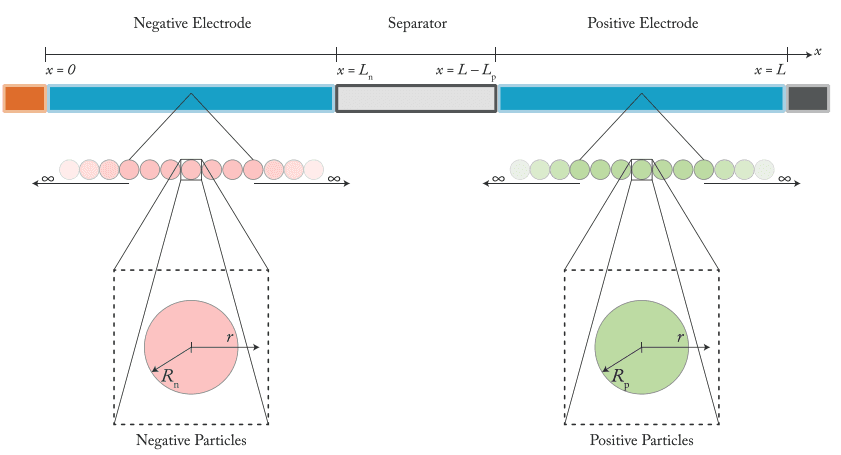
Doyle-Fuller-Newman model structure
What a physics-based electrochemical model is
A physics-based battery model represents the transport, reaction, and intercalation physics inside a cell from first principles, with parameters tied to real materials and geometry.
Lithium diffuses through an electrolyte, reacts at an electrode surface, and intercalates into solid particles. The model solves those equations across the electrode stack and predicts the terminal voltage as a function of current, temperature, and state of charge.
The Doyle-Fuller-Newman formulation (DFN, also called P2D or the Newman model) is the canonical form. SPM and SPMe are principled reductions of DFN that trade a small amount of accuracy for a large gain in speed.
The physics-based model family
SPM
Single particle model
One representative particle per electrode. Very fast. Accurate at low C-rate, where electrolyte gradients are small. Useful for long duty cycles, calendar studies, and first-pass scoping.
Read more →
SPMe
Single particle with electrolyte
Adds electrolyte transport to SPM. Recovers near-DFN accuracy across most automotive and grid duty cycles, at a fraction of the solve time. The practical default for many studies.
DFN / P2D
Doyle-Fuller-Newman
Full porous electrode theory with electrolyte transport through the thickness of the stack. The benchmark for accuracy, and the right choice for design optimization and high-C-rate or low-temperature behavior.
Read more →
+ extensions
Thermal, degradation, 3D
The base models extend to coupled thermal, degradation, pseudo-3D, and full 3D electrochemical studies using the same parameter set.
For a side-by-side comparison of ECM, SPM, SPMe, and DFN with parameterization burden, compute cost, and degradation capability scored against each other, see the electrochemical model types resource.
Physics-based vs. equivalent circuit
Both have their place. Which one fits depends on what the team is actually trying to predict.
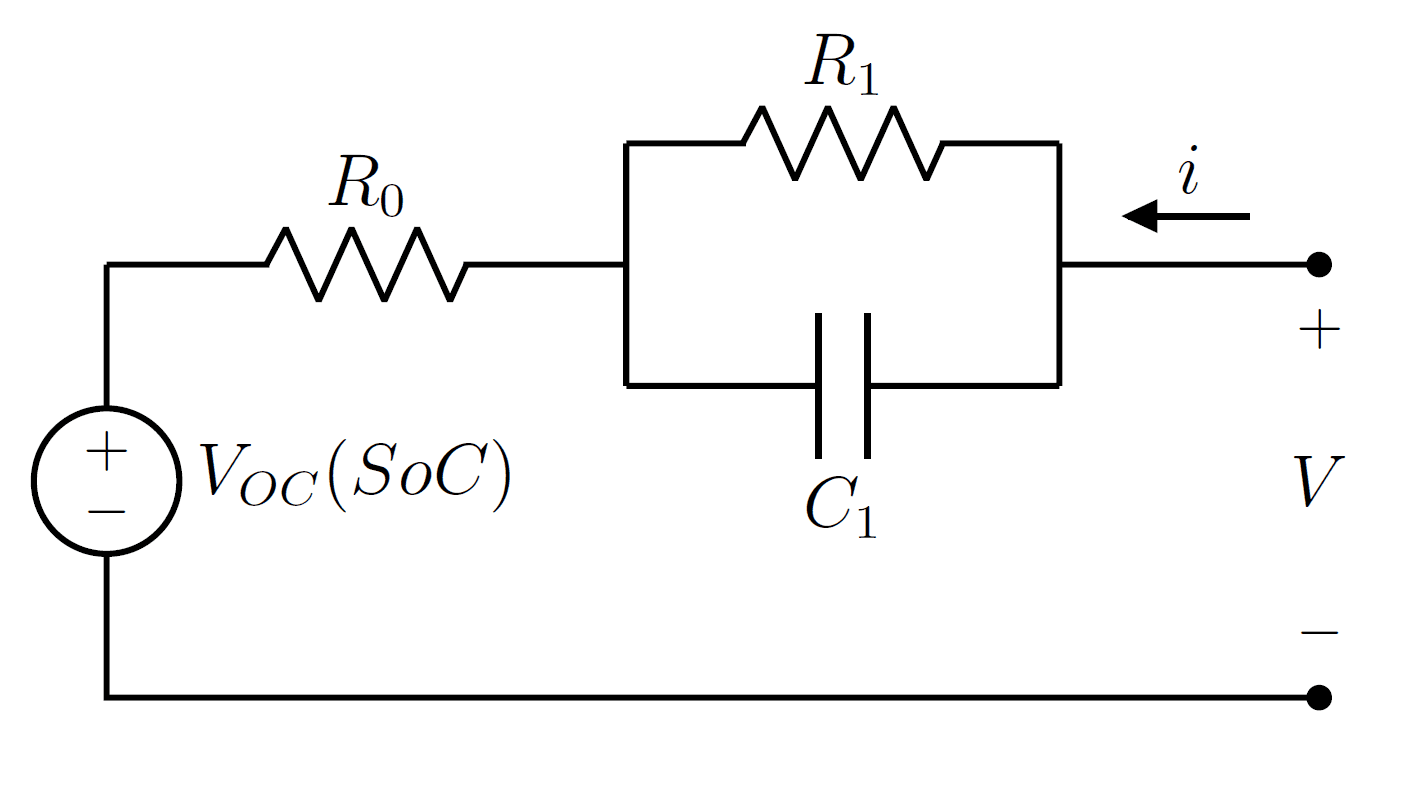
Equivalent circuit model
Physics-based model (DFN)
| Question | Physics-based | ECM |
|---|---|---|
| Extrapolate outside tested window | Yes | No |
| Explain why a cell behaves a certain way | Yes | No |
| Real-time BMS or onboard estimation | No | Yes |
| Fit from sparse pulse data | No | Yes |
| Design optimization (loading, porosity, thickness) | Yes | No |
SPM, SPMe, and DFN: accuracy and speed
| Model | Accuracy | Speed | Use when |
|---|---|---|---|
| SPM | Good at low C-rate | Very fast | First-pass scoping, long duty cycles, calendar aging |
| SPMe | Near-DFN through moderate C-rate | Fast | Most automotive and grid duty cycles |
| DFN | Benchmark | Slower | Design optimization, fast charge, low temperature |
Parameterization is the real work
The equations are settled. What determines whether a physics-based model predicts your cell correctly is the parameter set: diffusion coefficients, reaction rate constants, transport properties, open-circuit voltages, particle sizes. Most of these cannot be measured directly on a commercial cell. Some have to be inferred from cycling data.
Identifiability matters more than raw fit quality. A model that fits one discharge curve perfectly by pushing two parameters in opposite directions will fail on the next one. The workflow has to pin parameters to data that isolates them, and flag the ones that remain coupled.
This is the Train stage in Ionworks Studio. A parameter set fit here drives every downstream study.
How Ionworks fits in
How Ionworks supports physics-based models
01
PyBaMM as the solver
Ionworks is built on PyBaMM, the open-source battery modeling framework maintained by the Ionworks team. Models are first-class objects: DFN, SPM, SPMe, and custom submodels all run through the same interface.
02
Parameters carry across the workflow
A parameter set fit in Train drives capacity curves, fast-charge studies, thermal runs, and design sweeps in Predict and Optimize. Teams do not re-fit per study.
03
BPX parameter exchange
Ionworks supports BPX, the community standard for physics-based battery parameter sets. Teams can import vendor-supplied BPX files or export their own for sharing with partners and suppliers.
04
Immutable parameterized models with provenance
Every parameterized model records which dataset it was fit to, which cells were used, and when. The model you run in a design study six months from now is the same model you shipped to your stakeholders.
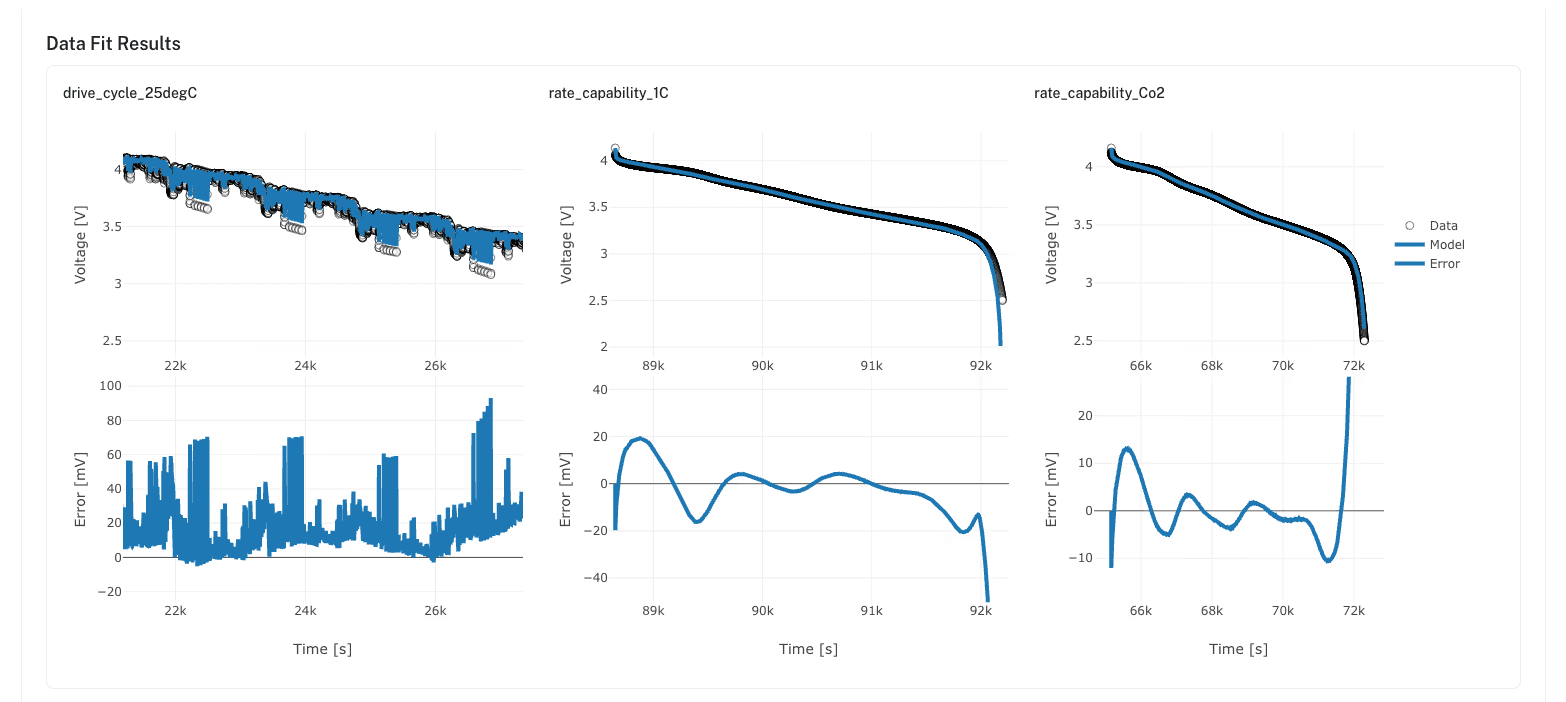
Parameterization in Ionworks Studio
Example questions teams answer
Energy-power tradeoff
How thick can I coat this electrode before the resulting cell cannot deliver the power the application needs?
Fast-charge limits
What is the fastest charge rate that avoids lithium plating across the temperature range this cell will see in the field?
Silicon content tradeoff
How does increasing silicon content in the anode change energy density, rate capability, and cycle life for a target duty cycle?
Frequently asked questions
Designing cells in software
White paper · PDF
A model parameterized from standard tests tracks LG M50 voltage to under 10 mV over 95% of each discharge from C/10 to 1C, then answers two design questions before a cell is built.
Get the white paper
See DFN, SPM, and SPMe side by side on your cell
Bring a dataset from one of your cells. We will show what each model gets right and where the accuracy-speed tradeoff lands for your workflow.