This comparison is published by Ionworks. We build on PyBaMM and have a clear interest in its success. We have aimed to represent both tools fairly based on publicly available documentation, published benchmarks, and our own experience using both tools in battery R&D projects. Where we make a recommendation, we say so and explain why.
PyBaMM and COMSOL are the two most commonly compared tools for physics-based battery modeling, and the comparison comes up in nearly every battery R&D team we work with. The tools overlap in one important area (both can solve the DFN model) and diverge in almost everything else: scope, speed, workflow, cost, and the kind of team they serve best.
This page covers the technical differences, the practical tradeoffs, and the situations where each tool is the right choice. If your team is evaluating both, or wondering whether one can replace the other, this should give you a clear framework.
What each tool is
PyBaMM (Python Battery Mathematical Modelling) is an open-source, general-purpose battery modeling framework written in Python. It ships with a library of electrochemical models (SPM, SPMe, DFN, composite electrodes, and more) and a broad set of degradation mechanisms, but it is not limited to them: PyBaMM separates models, discretization, and solvers so teams can define custom physics, couple electrochemistry to thermal and mechanical effects, and run in 1D, 2D, or 3D. Chemistries include lithium-ion, sodium-ion, and a growing set of others. It is maintained by an independent open-source community with contributions from universities and industry labs worldwide.
COMSOL Multiphysics is a commercial finite element analysis platform. The Battery Design Module adds Newman-type electrochemical models in 1D, 2D, and 3D, with coupling to COMSOL's thermal, structural, and fluid dynamics solvers. COMSOL's strength is cross-domain physics: battery electrochemistry sits alongside structural mechanics, CFD, and electromagnetics inside one environment, and can be coupled to any of them at the module or pack level.
The fundamental difference is not "battery library vs multiphysics platform" — PyBaMM is a capable multiphysics solver for battery systems in its own right. The real split is scope and workflow. COMSOL's differentiator is coupling battery physics to non-battery engineering domains (pack-level CFD, enclosure structural analysis, electromagnetic effects). PyBaMM's differentiator is speed, openness, and a battery-native workflow — which is what Ionworks productizes for teams that need it in shared infrastructure rather than individual notebooks.
Modeling scope
Electrochemical models
PyBaMM and COMSOL are both general frameworks for solving battery physics. This section covers their built-in electrochemical model menus; the multiphysics and higher-dimensional story is in the next section.
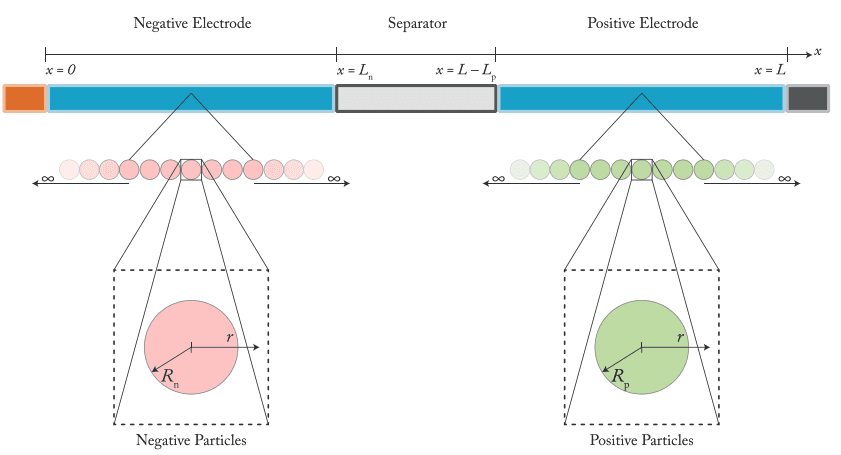
Both tools implement the DFN (Doyle-Fuller-Newman) model, and both produce accurate results. PyBaMM's own documentation includes a benchmark notebook comparing DFN discharge curves between PyBaMM and COMSOL, showing close agreement.
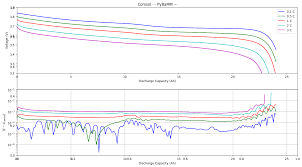
DFN discharge curves at multiple C-rates. COMSOL (solid) and PyBaMM (dashed) produce near-identical results across the full operating range. Source: PyBaMM COMSOL benchmark notebook.
PyBaMM offers more electrochemical model variants out of the box. SPM and SPMe are useful for fast exploration before committing to full DFN resolution. Composite electrode models, half-cell models, and user-defined submodels are first-class: switching between model types is a one-line change in Python.
Because PyBaMM is built as a modular framework, the set of available models is not a fixed menu. Teams can combine submodels for electrochemistry, thermal behavior, mechanics, and degradation, or swap in entirely new governing equations, without modifying the core library. The pre-built model library is a starting point, not a ceiling — which is why PyBaMM is used for everything from standard lithium-ion DFN work to research-grade sodium-ion, lithium-sulfur, and composite-electrode studies.
Both tools can run 2D and 3D electrochemical and thermal simulations today. The practical difference is packaging. COMSOL ships a desktop environment built around higher-dimensional modeling, with meshing and solver configuration exposed through the GUI. Ionworks ships 2D and 3D electrochemical and thermal simulations as ready-to-run workflows on top of PyBaMM, with meshing, solver config, and post-processing handled for the team. Teams running open-source PyBaMM can build the same simulations directly — the capability is there, the workflow just isn't pre-packaged.
Degradation modeling
PyBaMM has extensive degradation model support: SEI growth (multiple formulations), lithium plating (reversible and irreversible), particle cracking, loss of active material, and combinations of these mechanisms. Adding or modifying a degradation submodel is part of the library's design. This is one of the areas where PyBaMM's research-oriented architecture shows its strength. New degradation physics from the academic literature can be implemented and tested quickly.
COMSOL supports degradation modeling through its physics framework, but it requires more manual configuration. You can implement SEI, plating, and aging effects by defining the governing equations in COMSOL's PDE interface. The flexibility is there, but the setup cost is higher, and there is no equivalent of PyBaMM's library of pre-built, peer-reviewed degradation models.
Thermal and multiphysics
PyBaMM supports coupled thermal-electrochemical modeling in 1D, 2D, and 3D, along with mechanical effects like intercalation-induced stress and electrode expansion. The physics is there; what open-source PyBaMM does not provide is a ready-to-run pipeline for higher-dimensional thermal or stress simulations. Teams typically assemble that themselves.
Ionworks packages these workflows out of the box. Coupled 3D thermal-electrochemical simulations — heat generation from irreversible losses, Joule heating, entropic effects, resolved across pouch or prismatic geometries — run as a standard workflow on top of PyBaMM, with meshing, solver configuration, and post-processing handled for the team.
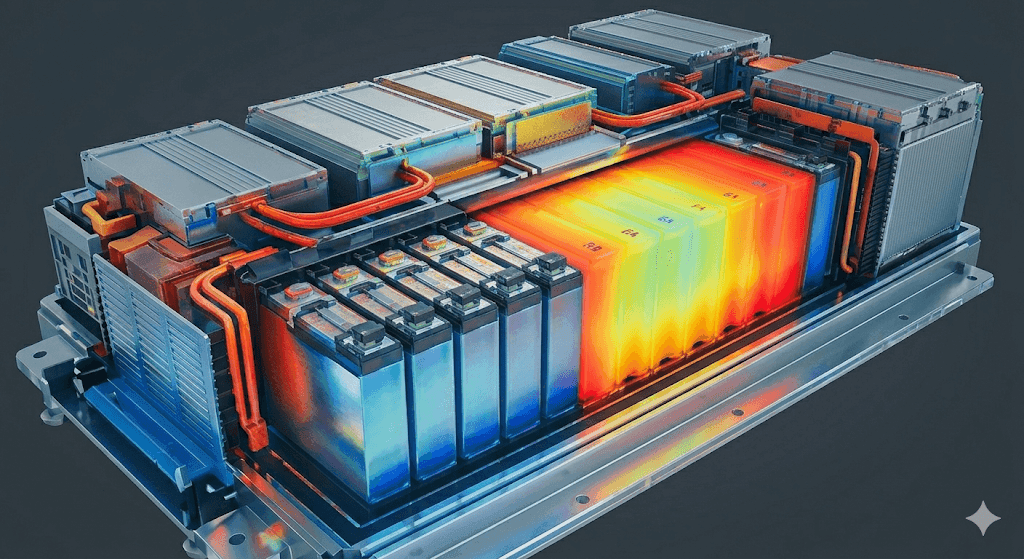
COMSOL's advantage is cross-domain physics at the module and pack level. It couples battery electrochemistry with pack-scale CFD (coolant flow through cooling channels), structural analysis of enclosures and modules, and electromagnetic effects in one environment. A typical COMSOL use case: 3D thermal distribution across a prismatic module during fast charging, coupled to a pack-level cooling system CFD simulation and the surrounding enclosure mechanics.
If the question is about coupled electrochemistry, thermal, and mechanical effects at the cell level, PyBaMM covers it, and Ionworks makes it a turnkey workflow. If the question extends into pack-level CFD, module-scale structural analysis, or electromagnetic coupling, COMSOL remains the more capable tool.
Computational speed
For standard 1D electrochemical models, PyBaMM is typically more than 10x faster than COMSOL. A 2025 peer-reviewed study by Nwanoro et al. in Advanced Theory and Simulations benchmarked several battery modeling tools and found PyBaMM to be more than an order of magnitude faster than COMSOL across a range of conditions.
The speed difference matters most for workflows that involve many simulations: parameter estimation (which may require hundreds or thousands of forward model evaluations), protocol sweeps, and design optimization studies. When each simulation takes seconds instead of minutes, the scope of what a team can explore in a day changes fundamentally.
For 2D and 3D simulations, Ionworks brings the same speed-oriented numerical approach to higher dimensions, though 3D problems are inherently more expensive regardless of the tool. COMSOL remains the right call when the problem requires coupling battery physics to pack-level CFD, enclosure structural analysis, or other non-battery engineering domains.
Parameter estimation and model fitting
Parameter estimation is where the workflow differences between the two tools become most apparent.
PyBaMM is well-suited for parameter estimation because its fast execution time makes iterative fitting practical. Teams typically use PyBaMM with SciPy or custom optimization loops to fit parameters to experimental data. The model's Python API makes it straightforward to define objective functions, run gradient-free or gradient-based optimizers, and process the results programmatically. The limitation is that all of this happens in code: the engineer needs to write and maintain the fitting pipeline.
Ionworks adds a structured parameterization layer on top of PyBaMM: global optimization with multistart, uncertainty quantification for each estimated parameter, Bayesian priors for incorporating literature values, and parallel execution so large parameter sweeps complete in minutes. The parameter sets and their provenance (which data, which model, which fitting configuration) are stored and versioned. This is the operational gap that PyBaMM alone does not fill.
For teams that have the data but not the modeling capacity, Ionworks also offers battery simulation consulting: fixed-scope projects where our team fits the model to your data and delivers a validated parameter set with full provenance. Standard SPM/SPMe/DFN fits, custom chemistry models, and degradation studies are all available as consulting engagements. Every deliverable is yours to keep.
COMSOL supports parameter estimation through its Optimization Module, which can fit model parameters to experimental data. The setup requires defining the optimization problem within COMSOL's interface, and the slower simulation speed means the estimation loop takes longer per iteration. For a DFN model with ten or more parameters, this translates to a meaningfully longer wall-clock time for the full fitting process.
Workflow and team access
Interface
COMSOL provides a full desktop GUI. Models are built by defining geometry, physics, meshing, and study steps through the interface. The Application Builder lets teams create simplified front-ends for specific workflows, which can be deployed through COMSOL Server. This is useful for giving non-specialist users access to pre-configured simulations.
PyBaMM is code-first. Every simulation requires Python scripting. For individual researchers and small teams with strong Python skills, this is not a limitation. For teams with mixed skill levels, or organizations where multiple people need to run simulations, the code-first approach creates a bottleneck: whoever wrote the notebook becomes the single point of access.
Ionworks provides a web-based GUI for PyBaMM-powered workflows: data ingestion, parameterization, simulation, and optimization through a browser interface. The API and SDK remain available for everything else. This is the production layer for teams that need PyBaMM's models without requiring every team member to write Python.
Reproducibility
COMSOL models are saved as .mph files containing the full model definition. This makes individual models shareable, though version control for binary files is awkward, and linking simulation results back to specific experimental datasets requires external discipline.
PyBaMM models, parameter sets, and notebooks can be serialized and version-controlled, and a single engineer can absolutely reproduce their own work. The harder problem is across a team: someone needs to know which notebook is current, which parameter file matches which cycling dataset, and which run produced the figure in last month's review. In most groups that lives in a mix of local drives, email, and Slack.
Ionworks stores parameterized models, protocols, and simulation results in a shared cloud database as versioned, linked objects. A parameterized model records its parameter set, the cycler data it was fitted to, and the fitting configuration. Simulations record the exact parameterized model and protocol used. Every member of the team reads from the same source of truth, so reproducing a colleague's result is "open the run" rather than "find the person who made it."
Licensing and cost
PyBaMM is free and open-source under the BSD 3-Clause license. No license fees, no seat limits, no restrictions on commercial use. For teams with strong Python skills and no need for production infrastructure, this is hard to beat.
COMSOL requires a commercial license. The base COMSOL Multiphysics platform is needed, plus the Battery Design Module for battery-specific physics. Additional modules (Heat Transfer, Structural Mechanics, Optimization) add to the cost. COMSOL does not publish pricing publicly; quotes depend on license type (perpetual vs. subscription, floating vs. node-locked), module selection, and seat count. Academic pricing is available at a discount.
Ionworks is a commercial SaaS platform. Pricing is in a similar range to COMSOL for comparable team sizes. The difference is in what you're paying for: Ionworks is purpose-built for battery simulation workflows (parameterization, protocol simulation, degradation studies, optimization), while COMSOL provides broader multiphysics coverage across many engineering domains. Contact us for pricing details.
When to use COMSOL
COMSOL is the right choice when:
You need to couple battery physics with other engineering domains at the module or pack level. Pack-level coolant flow and thermal management CFD, enclosure and module structural analysis, electromagnetic effects: COMSOL handles these in a single environment and couples them to battery electrochemistry. Neither PyBaMM nor Ionworks provides pack-scale CFD or structural solvers.
Your team already has a COMSOL installation and expertise. If the organization has invested in COMSOL licenses, training, and established modeling workflows, extending that investment to battery simulation avoids the overhead of adopting a new tool.
When to use PyBaMM
PyBaMM is the right choice when:
Electrochemical modeling at the cell level is the core problem. SPM, SPMe, DFN, and their extensions are PyBaMM's native territory. If 1D electrochemistry answers your question, PyBaMM gives you more model options and faster execution.
Degradation modeling matters. PyBaMM's library of degradation mechanisms (SEI, plating, cracking, loss of active material) is broader and more immediately accessible than what COMSOL offers for aging studies.
Parameter estimation drives the workflow. Fitting a model to experimental cycling data requires running the forward model hundreds of times. PyBaMM's speed advantage makes this practical. With Ionworks, the fitting pipeline is structured, parallelized, and stores results with full provenance.
The team needs to run many simulations. Protocol sweeps, sensitivity analyses, and design optimization studies all scale better when individual simulations are fast. PyBaMM (and Ionworks Predict) makes high-throughput simulation practical.
3D thermal-electrochemical modeling at the cell level matters. PyBaMM supports it, and Ionworks ships it as a ready workflow, so teams that previously adopted COMSOL for cell-level thermal gradients can stay within the PyBaMM ecosystem.
Open-source matters. Full access to model code, community contributions, and no vendor lock-in. The model you develop in PyBaMM can be inspected, modified, and shared without licensing constraints.
Your team needs help getting started. Ionworks offers battery simulation consulting for teams that have data and a modeling question but not the in-house capacity to build the pipeline. A fixed-scope engagement delivers a validated parameterized model your team can run and refit. This path does not exist in the COMSOL ecosystem in the same form.
When teams use both
The most common pattern we see: PyBaMM (often through Ionworks) for cell-level electrochemical, thermal, and mechanical work, and COMSOL for pack-level CFD and module-scale structural analysis.
A typical workflow: fit a DFN model to cycling data using Ionworks. Validate against test protocols. Run degradation studies, protocol sweeps, and 3D thermal-electrochemical simulations at the cell level. Then export validated parameters into COMSOL for pack-level CFD, module structural analysis, or system-level thermal management.
Teams that previously adopted COMSOL for cell-level thermal questions can now handle those inside the PyBaMM ecosystem through Ionworks and reserve COMSOL for the domains it uniquely covers: pack-scale CFD, enclosure mechanics, and coupling battery behavior to other engineering disciplines.
Teams do not need to choose one or the other. The choice is about matching the tool to the question.
Comparison table
| Dimension | PyBaMM | COMSOL |
|---|---|---|
| Type | Open-source Python battery modeling framework | Commercial FEA platform |
| Electrochemical models | SPM, SPMe, DFN, composite electrodes, half-cell, custom user-defined submodels | Newman models (1D, 2D, 3D) |
| Spatial dimensions | 1D, 2D, 3D (higher-dimensional workflows productized via Ionworks) | 1D, 2D, 3D |
| Degradation models | SEI, plating, cracking, LAM (pre-built library, extensible) | Configurable via PDE interface (manual setup) |
| Thermal and mechanical | Coupled thermal-electrochemical and intercalation stress at any dimension; 3D productized via Ionworks | Full 3D thermal, fluid, and structural coupling across battery and non-battery domains |
| Simulation speed (1D DFN) | Fast (seconds for typical discharge) | Typically 10x+ slower |
| Parameter estimation | Code-based; fast iteration via Python | Optimization Module; slower per iteration |
| Interface | Python scripting | Desktop GUI + Application Builder |
| Team workflow | Notebooks; collaboration requires file sharing | .mph files; COMSOL Server for deployment |
| Chemistries | Li-ion, Na-ion, and growing set | Li-ion (primary focus of Battery Design Module) |
| Cost | Free (BSD 3-Clause) | Commercial license (pricing on request) |
| With Ionworks | Web GUI, 3D modeling, structured parameterization, team collaboration, consulting services | N/A |
Where Ionworks fits
Ionworks is not a replacement for COMSOL's cross-domain multiphysics coupling. It is a production environment for PyBaMM-based battery simulation — the shared infrastructure that turns PyBaMM's capabilities into workflows a whole team can use.
What Ionworks adds on top of the PyBaMM ecosystem: packaged 2D and 3D electrochemical and thermal workflows. Structured cycler data management. Parameterization with global optimization, uncertainty quantification, and Bayesian priors. Protocol-driven simulation with versioned, linked results stored in a shared cloud database. Physics-based design optimization. A web interface so the whole team can run simulations, not just the person who writes Python.
For teams that need help building their first model, Ionworks also provides battery simulation consulting: parameterization, degradation modeling, custom chemistry models, and optimization studies delivered as fixed-scope projects. Every deliverable is yours to keep.
For a broader comparison covering Ansys, Gamma Technologies, Siemens, and other battery simulation software, see the full battery simulation software comparison.
For teams evaluating PyBaMM, COMSOL, or both: book a demo to see how Ionworks turns PyBaMM models into repeatable team workflows, from cycler data import to parameterized models to design optimization.
Frequently asked questions
Continue reading