In October, we shared first results from our eVTOL cell design work with Avrion Battery Labs. Today we are releasing the full application note, which we wrote together with the Avrion team.
Designing a new battery cell is mostly a cycle of building and testing. A team picks an electrode design, builds cells, tests them, and adjusts. Each round takes two to three months, and most programs need three to four rounds.
Simulation-assisted design does not replace these builds. It combines them with a model in one feedback loop. The model explores the possible designs, and the builds test and refine the model. Most teams already build fewer cells than they want to, because of cost and time. A model helps them get further with the builds they can afford.
The note asks how simulation-assisted design can help a cell program. Can it reduce the number of build-and-test rounds? Can it lead to better cells? And can it help teams understand the trade-offs between designs? To answer these questions, we recorded every model prediction before Avrion built any cells. We then compared the predictions with the measured cells, including designs the model had never seen. Download the application note.
The test
eVTOL aircraft (electric vertical take-off and landing) ask a lot of their batteries. We designed cells for two eVTOL flight profiles, or missions. Both designs use the same materials and pouch format, but the missions need different electrodes.
- Standard mission. A steady 2 W cruise continues until the cell is empty. More stored energy gives a longer flight.
- Go-around mission. The energy needed is fixed. The flight ends with a 10 W landing burst when the cell is nearly empty, so the cell must still deliver high power at the end.
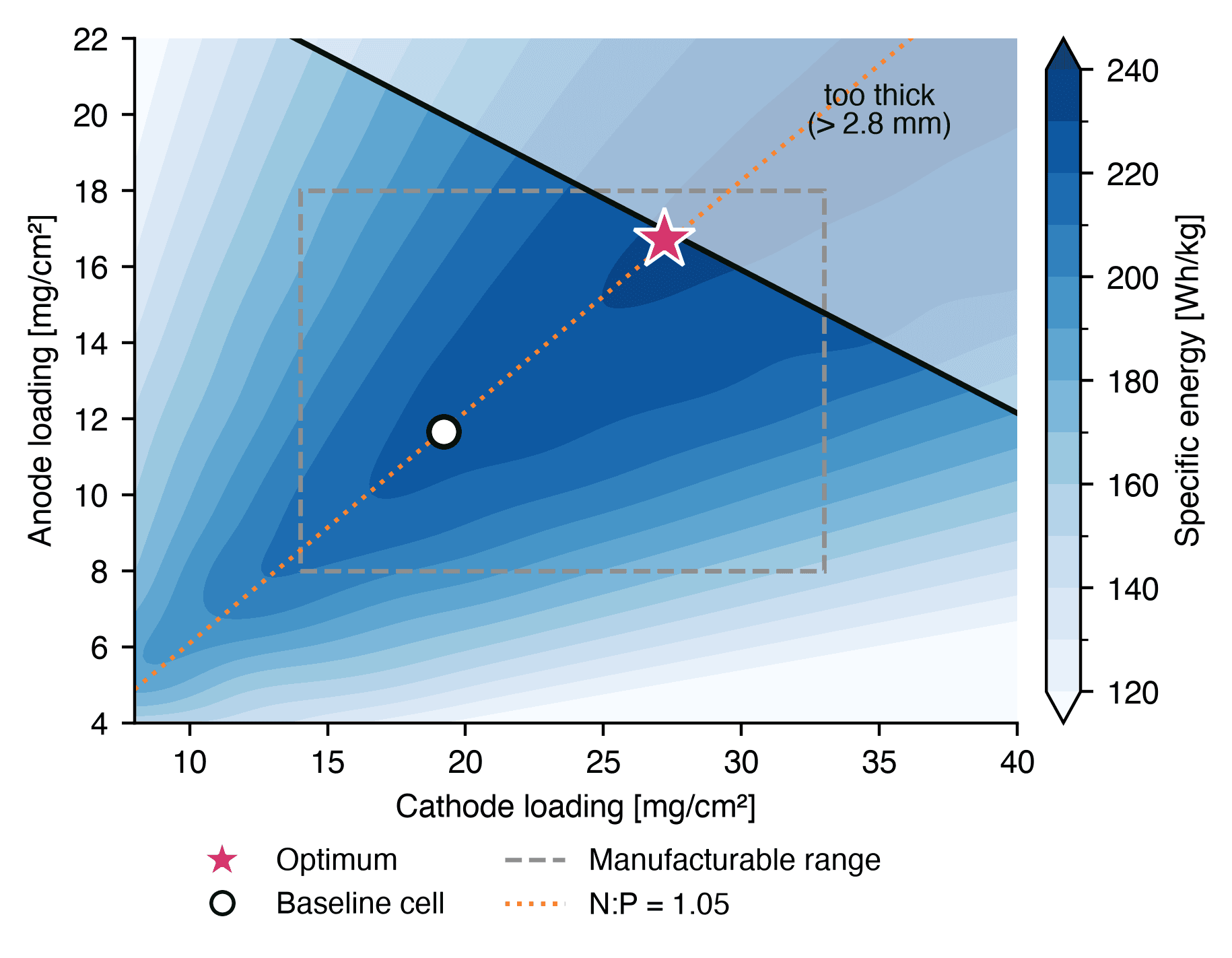
The main design choice is electrode thickness, measured as loading: how much active material sits on each square centimetre of electrode. Thicker electrodes store more energy. Thinner electrodes deliver power more easily.
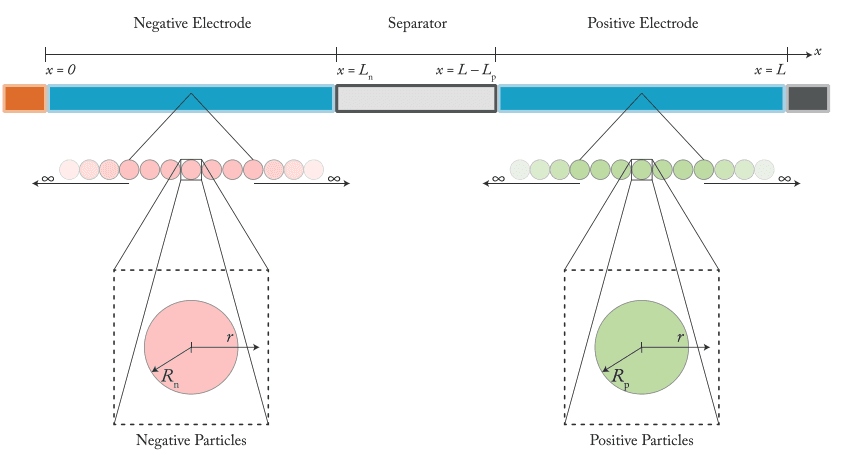
We built a physics-based model of Avrion's baseline cell (a lithium-ion cell with an NMC811 cathode and a graphite anode) and fitted it to test data from that cell using ionworkspipeline. The model then screened thousands of candidate designs for the two missions. Each design had to:
- fit within a 2.8 mm electrode stack
- have at least 5% more anode capacity than cathode capacity
- avoid lithium plating, a side reaction that damages the cell
- stay above 2.8 V during the power bursts
Avrion built 19 designs, 57 cells in total, in three pairings of cathode and anode. Pairing A was the model's pick for the standard mission. Pairing B was its pick for the go-around mission. Pairing C was a control with extra anode. Avrion tested each cell on its own mission, on the other mission, and at a range of discharge speeds, from five hours down to 20 minutes.
Key findings
1. The model chose the right designs before any cell was built
The model chose thicker electrodes for the standard mission and thinner electrodes for the go-around mission. The built cells showed the same trends.
That direction is not a surprise. The useful part is that the model found the exact thickness. For the go-around mission, it set the cathode loading 27% below the baseline. At that point the electrodes can only just deliver the 10 W burst above 2.8 V. Thicker electrodes can't deliver the burst. Thinner ones can, but they carry more inactive material, so the cell stores less energy for its weight. If you design for energy alone, you don't find this point.
The model also shows why each design sits where it does. The standard-mission design is limited by the stack thickness and the anode-to-cathode ratio. The go-around design is limited by how fast lithium can move through the cell during the final burst. This tells you which limit to relax if you want more from each design.
2. 21% more energy per kilogram on the go-around mission
The go-around design stored 21% more energy per kilogram of electrode stack than the baseline cell. The model predicted 25%. Including the pouch and electrolyte, the gain was 16%.
On the standard mission, the baseline cell was already close to the best design. The best build gained 0–3%.
3. One round of builds was enough to refine the model
The first builds showed four things the model did not include:
- how much usable lithium the cells with extra anode really had
- the extra resistance in densely pressed anodes
- the resistance of the reaction at the anode surface
- the mass of the electrolyte and the pouch
We added one physical term for each. Two of them improved predictions for designs the model had not been fitted to. Both come from how the cells are made. The usable lithium comes from the cathode and the lithium lost when the cell is first charged. The cell mass comes from Avrion's bill of materials.
The other two terms were fitted to the mission data. They matched those tests well, but on new designs they made the model look four to six times more accurate than it really was.
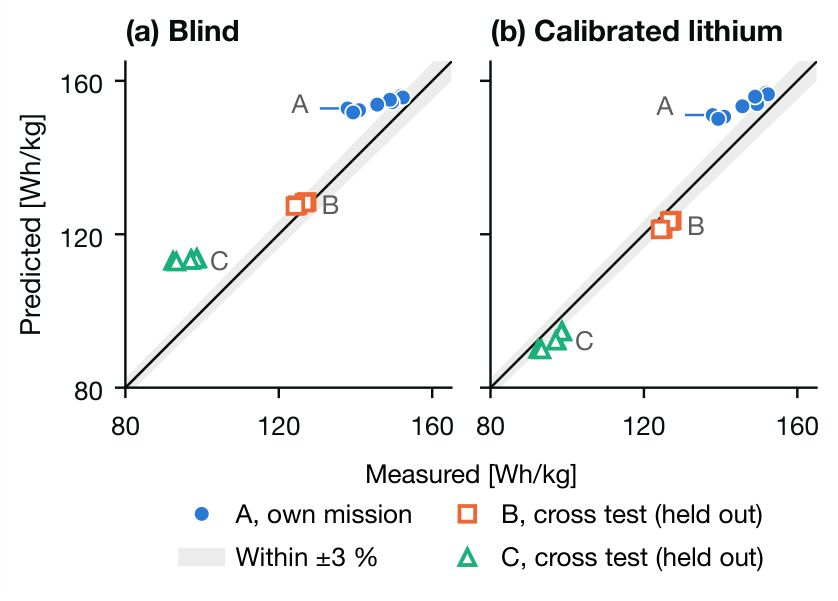
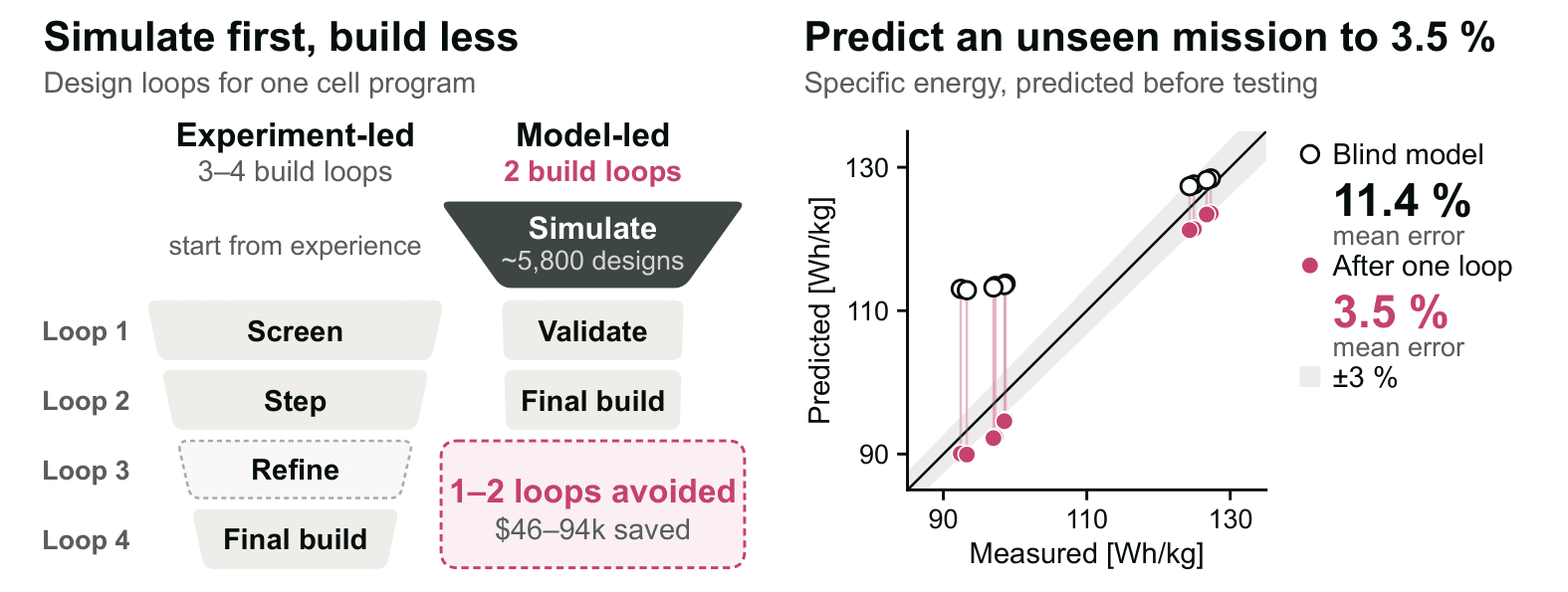
After one round, the model predicts energy per kilogram with a 3.5% mean error on tests it was not fitted to. Before the builds, the error was 11.4%.
A note on numbers: our October case study quoted 2.4%. That figure includes builds the refined model was fitted to. The 3.5% figure only counts tests the model had not seen.
4. More accurate than a design spreadsheet
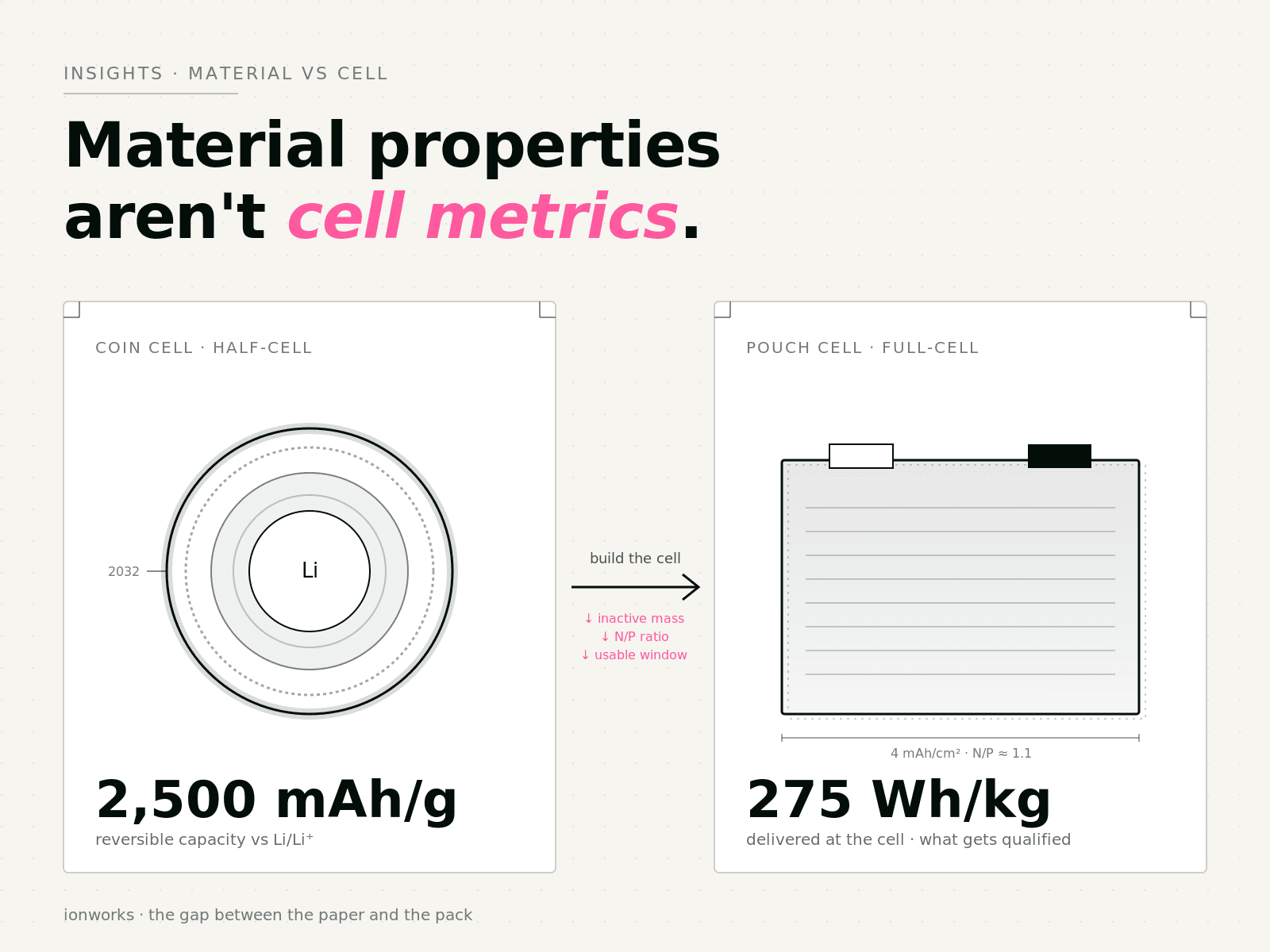
We compared the model with Avrion's design spreadsheet. The spreadsheet works out cell capacity from small test cells (coin cells) and energy from a fixed average voltage. Both methods had the same build data to learn from.
The question that matters most is how much you gain by changing electrode thickness. The model predicted that gain to within ±20% in five of six comparisons on unseen designs. The spreadsheet did this in one of six. The model was also more accurate on standard-mission energy in all three cases where a whole pairing was left out (3.5–7.2% error, against 4.5–11.3%).
We also tried two purely statistical methods that learn from the data without any physics. They work well when the new design is close to the ones they learned from. When a whole pairing was left out, their errors grew sharply.
This matters because choosing electrode thickness is the decision that uses the most build rounds in a typical program.
5. One to two fewer build rounds per program
A program that relies on builds alone usually needs three to four rounds. With the model doing the screening, two are enough. The first round checks and refines the model. The second is the final build.
For the small prototype cells in this study, that saves about $46–94k per program. If a model of the cell chemistry already exists, it also saves two to five months. Larger cells and programs save more.
Where the model stops
Knowing the limits is part of testing a model. The note reports three:
- For cathodes thicker than any in the cells used to build the model, it overpredicts energy per amp-hour by 8–12%.
- When the thickest electrodes are discharged in under an hour for several minutes, the salt in the electrolyte runs short, and this limits the cell. No version of the model captures this.
- For a given thickness, the model does not choose how hard to press the electrodes any better than a simple rule (press as little as possible).
So the cells used to build the model must cover the full range of electrode thickness. They must come from the same production line that builds the new designs. And they must be tested with the most accurate equipment available.
What this means for a cell program
Simulation-assisted design worked for the decision that costs the most build rounds: choosing electrode thickness. Before any cell was built, the model pointed each mission in the right direction and found a design with 21% more energy per kilogram. One round of builds was then enough to refine the model, and the refined model beat the design spreadsheet on designs it had not seen.
The builds were still essential. They found what the model was missing, and they confirmed the result. But with the model doing the screening, each build answered a sharper question. That is how a team gets better cells and a clearer view of the trade-offs, in fewer rounds.
Thanks to Connor Aiken, Stephen Glazier and Yadong Huang at Avrion Battery Labs. They built and tested every cell, and they co-wrote the note. Thanks also to Akhil Abraham, who started this collaboration and contributed to the first model, and to Lauren Thompson for her helpful review comments.

Continue reading