Conventional cell design is experiment-led: build a batch, test it, learn something, and build again. Each of those loops is slow and expensive, and a typical program needs three or four of them before it lands on a final design. Avrion Battery Labs and Ionworks set out to run cell development the other way round. A validated physics-based model maps the full design space and optimizes the electrodes for complex eVTOL missions virtually, so Avrion only builds the top candidates.
The results, measured on built cells:
- +21% specific energy for the high-power landing design against the baseline cell.
- 5 months faster per design program, from two build loops instead of four once the chemistry is parameterized.
- $930K saved annually, or $93K on every program, alongside freed-up pilot-line throughput.
The savings figure is modeled rather than measured. It assumes ten programs a year, three design parameters per program, and two build rounds saved per program.
Fewer build loops, better cells
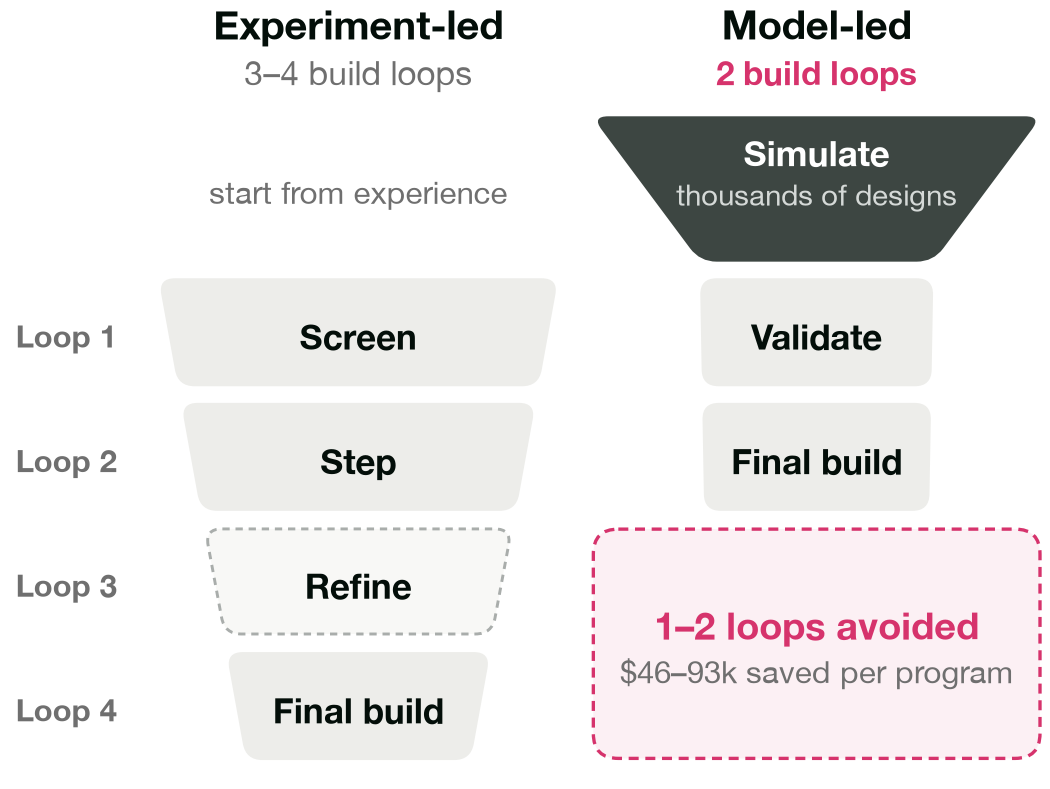
In an experiment-led program the first loop starts from experience: the team screens a handful of designs, steps toward a better one, refines it, and only then commits to a final build. In a model-led program the screening happens in simulation across thousands of designs. The first physical build validates the model's pick, and the second is the final build. That avoids one to two build loops, worth $46K to $93K per program.
Test data from each build loop also recalibrates the physics model, so every round narrows the set of candidates that need to be built.
The workflow has three steps.
Characterize. A few baseline cells, tested in half-cell and full-cell format, are enough to build the model.
Optimize. Ionworks screened 5,800 designs, which would have been 17,400 cells if built in triplicate. Because the search is virtual, it can grow far beyond any build plan.
Build and iterate. Avrion Battery Labs built 19 designs to validate the methodology. Complex programs loop, each time building on what the last round learned.
Predicting energy density within 5%
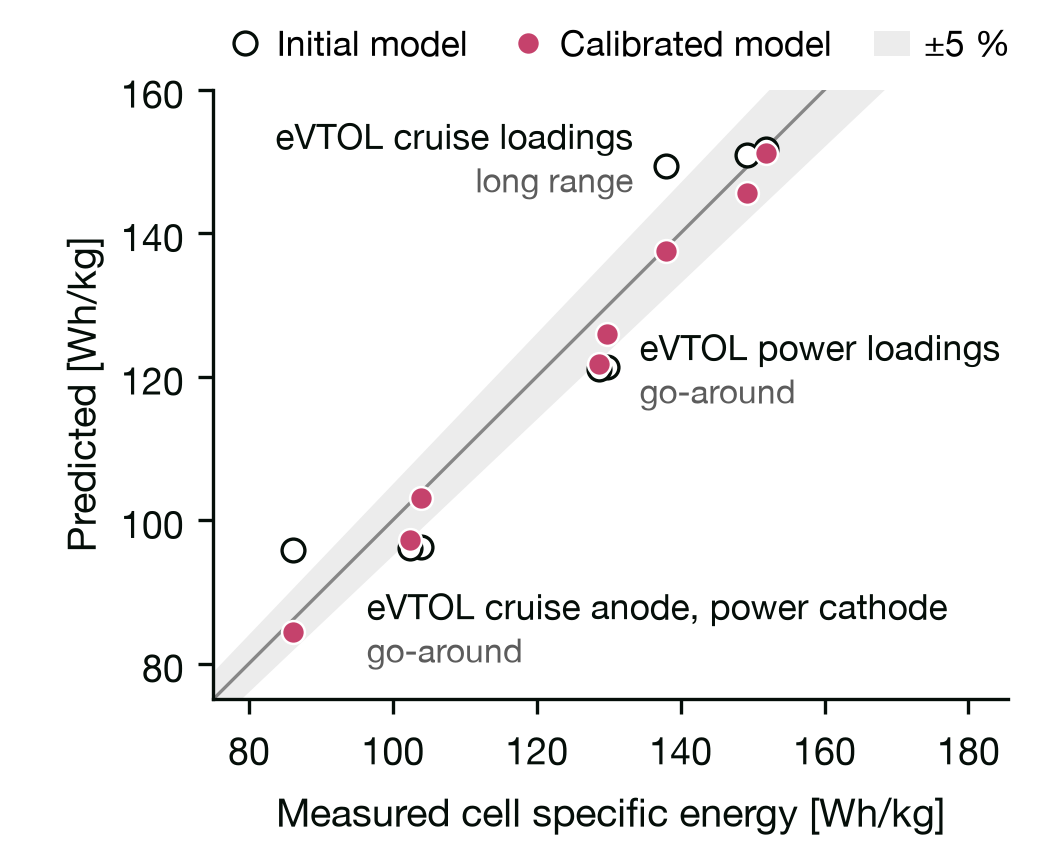
A model-led workflow is only as good as its predictions. Across all of Avrion's builds, spanning long-range cruise loadings, go-around power loadings, and a hybrid with a cruise anode and power cathode, the initial model predicted specific energy with a mean absolute error of 5.2%. Once recalibrated on test data, that fell to 2.4%. The bars in the figure span each build's cells, and the shaded band marks ±5%.
A few cells in, a 5,800-design DOE out
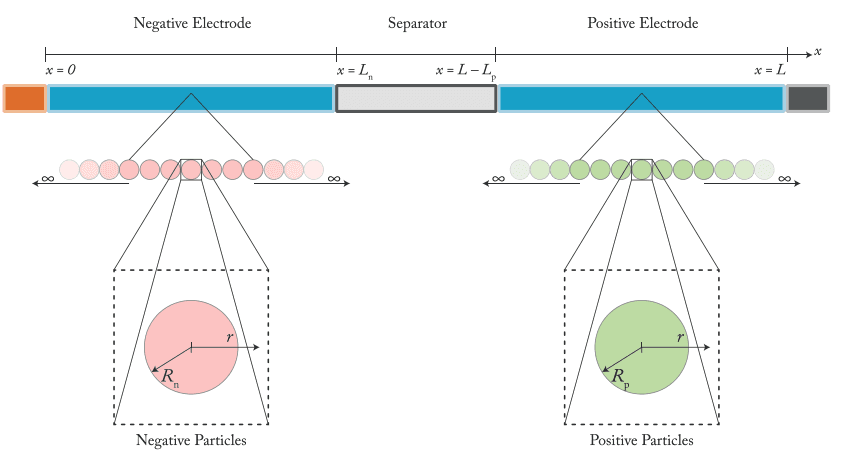
The model behind this is a Doyle–Fuller–Newman (DFN) model, built with the Ionworks pipeline from a couple of baseline 1 Ah pouch-cell designs. It maps the full electrode design space for a long-range eVTOL mission: take off, cruise as far as the cell allows, then land.
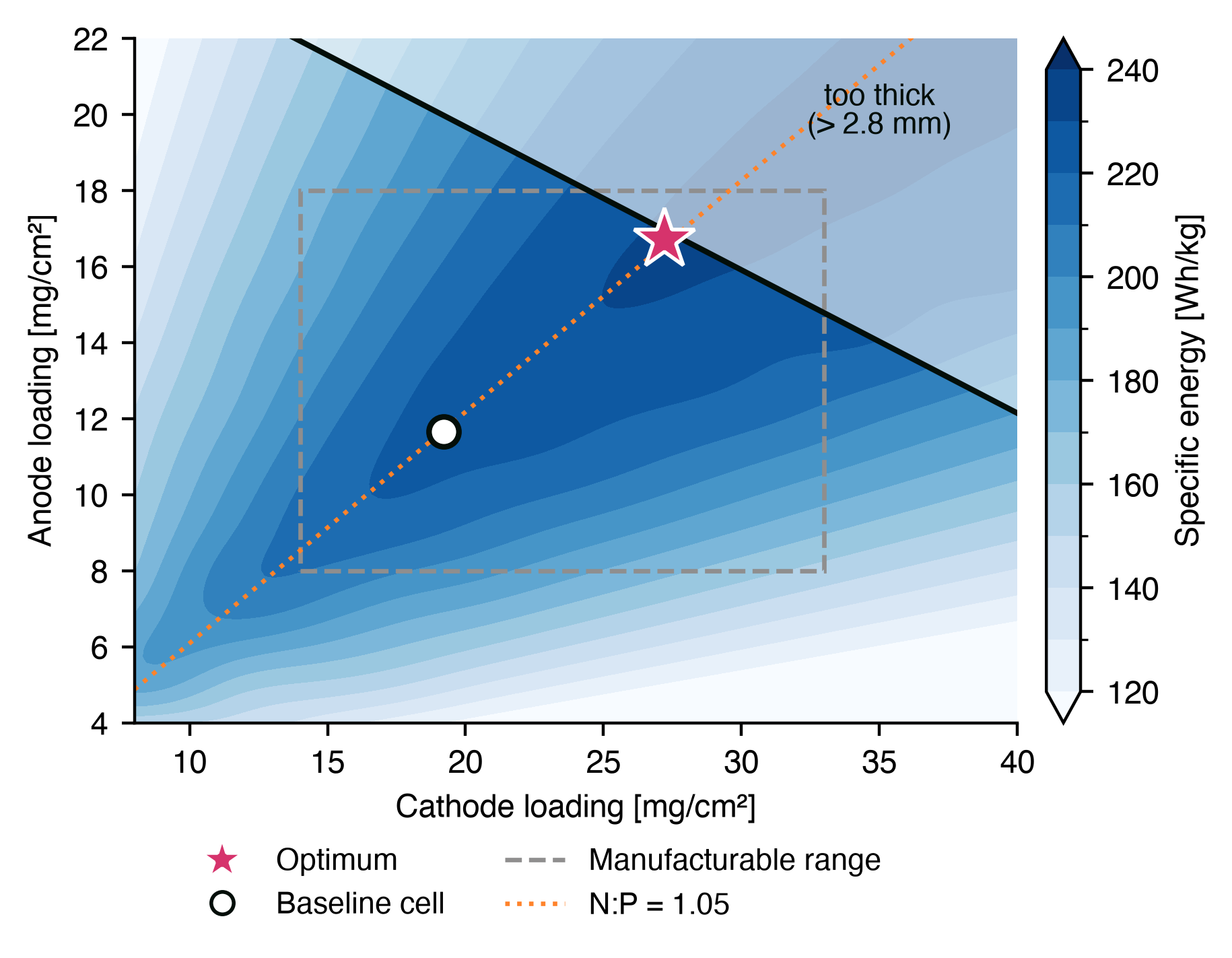
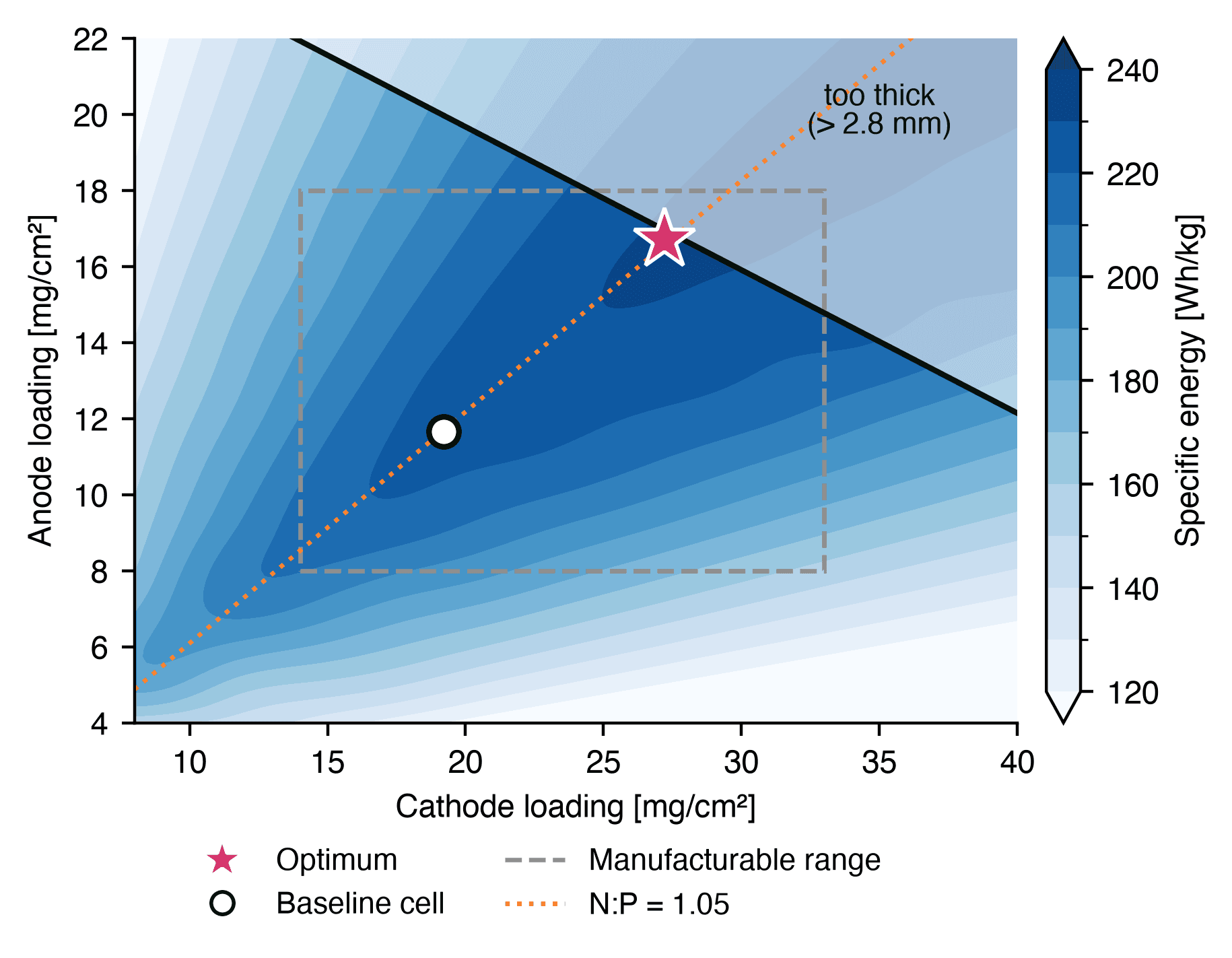
Every contour point on this landscape is a full DFN simulation of the mission and recharge, showing specific energy across cathode and anode loading. Heavier electrodes store more energy until the 2.8 mm thickness limit cuts them off, so the best long-range eVTOL design sits where that limit meets the N:P floor.
Rather than sweeping a fixed DOE grid, an optimizer searches the electrode loadings and press densities at once and heads straight for the best design. Because the search runs virtually, it covers far more of the design space than any build plan could. Each build loop starts closer to the optimum, so fewer loops are needed: better cells, sooner, for less.
Validating the time series, not just the end point
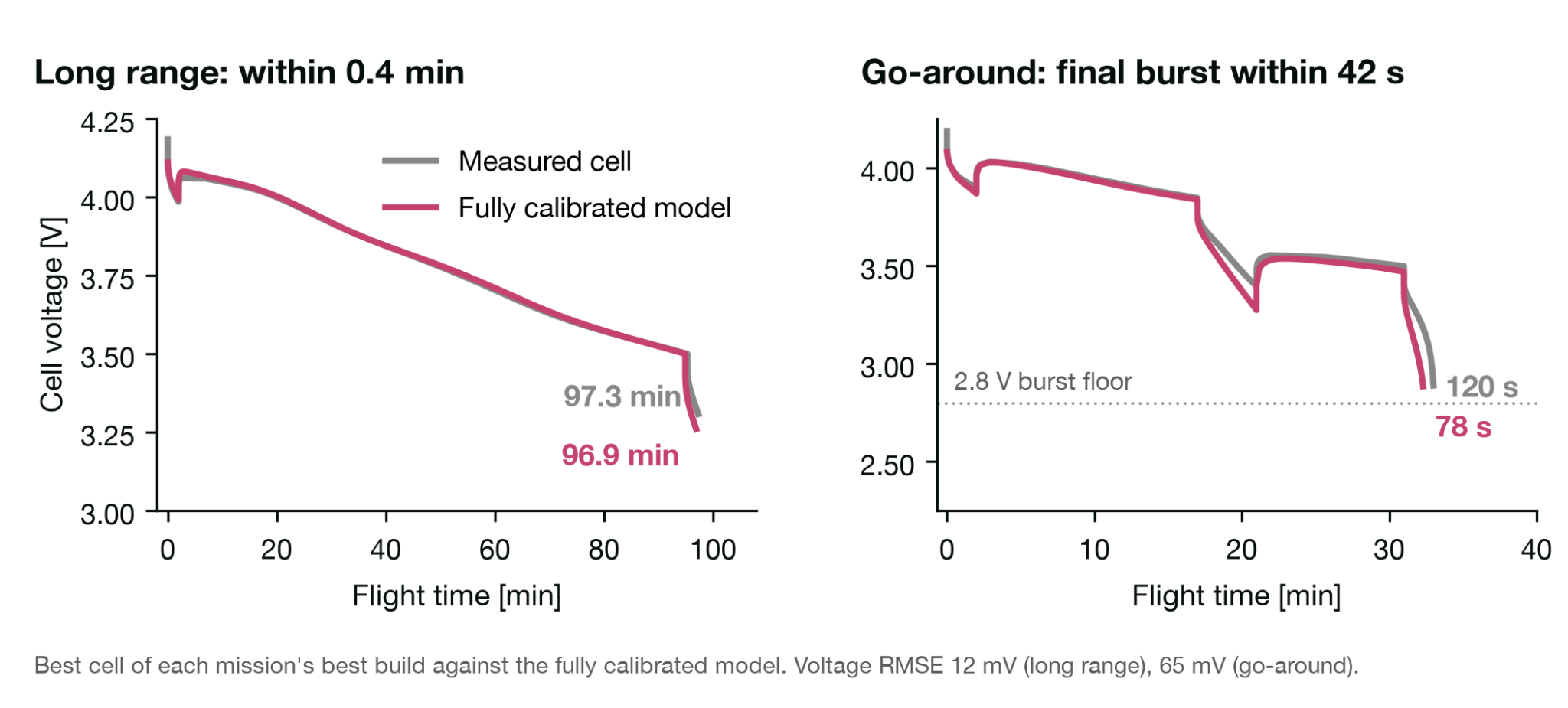
Matching a single energy number is one test. Matching the voltage trace through an entire mission is a harder one. The figure compares the best cell from each mission's best build against the fully calibrated model.
On the long-range mission, the model predicts flight time within 0.4 minutes: 96.9 minutes predicted against 97.3 measured, with a voltage RMSE of 12 mV. The go-around mission is more demanding, with a high-power burst at the end that runs the cell down to the 2.8 V floor. There the model predicts the final burst within 42 seconds, with a voltage RMSE of 65 mV.
The full two-page summary is available as a PDF: download the Avrion case study.
Continue reading