Who they are
FAAM is an Italian manufacturer of eco-friendly lithium-ion energy storage systems for industrial, automotive, and renewable-energy applications. Their cell-simulation team, three engineers inside R&D, turns cycling data into the parameterised cell models that underpin FAAM's degradation projection, capacity-fade work, and the warranty claims they make to stationary-storage customers.
The problem
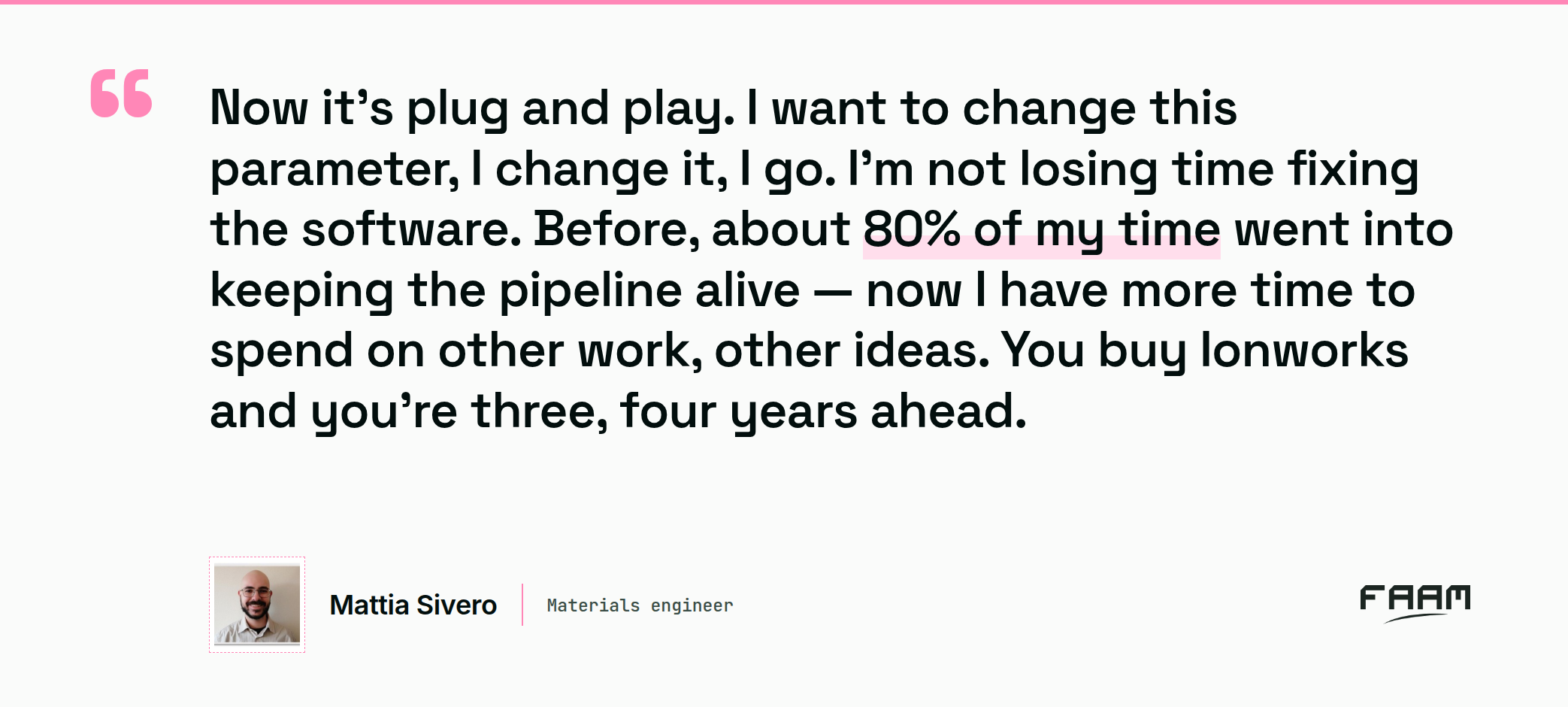
Building those models accurately is a core R&D competency. Before Ionworks, the team ran a self-built PyBaMM pipeline: cost function, minimiser, optimiser population, and all the orchestration around it. It worked, but it was substantial software infrastructure for a small group to own alongside the science. Roughly 80% of the lead engineer's time went into keeping it alive rather than into the modelling work that delivers on FAAM's product needs.
What changed
With Ionworks running the pipeline, the team's time moved from devops back to insight.
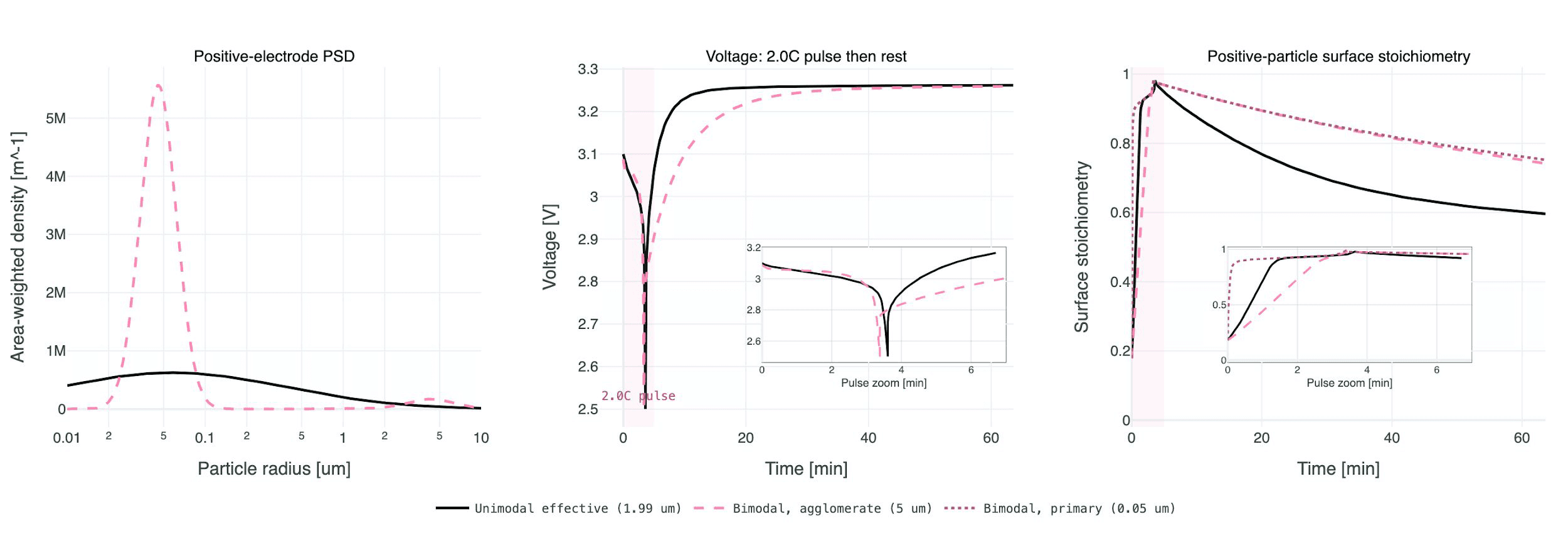
The clearest example is FAAM's LFP positive electrode. The coating is a mix of small primary particles and larger agglomerates, and capturing that distribution accurately is critical to a model that reflects reality. Earlier setups failed to resolve both the large- and small-particle dynamics at once, collapsing the distribution onto a single effective particle size and hiding the physics that drives pulse-rate behaviour. Ionworks helped parameterise and simulate the full distribution, so the cell model FAAM uses for downstream product decisions matches what is actually inside the cell.
The figure above shows the difference. Two positive-electrode particle-size distributions are matched on total surface area, the kind of constraint a team uses when replacing a measured distribution with a single-lognormal approximation. Under a distribution-aware solver the two keep their timescales separate, and the approximation becomes visible as a pulse-response difference in voltage and surface stoichiometry, rather than getting silently absorbed into a lumped diffusion coefficient.
Two chemistries now run in parallel without a second set of scaffolding, and protocol choices move through simulation before the cycler.
The business case
The return breaks down three ways:
- $150K/yr in direct operations savings. The lead engineer's split used to run roughly 80% infrastructure to 20% modelling. With Ionworks running the pipeline it inverts, and senior modelling capacity that used to absorb infrastructure work is back on the team's broader pipeline.
- A 30×+ build-vs-buy gap. On an annual spend of $50K with Ionworks. The in-house alternative is roughly $1.5M+ over three to four years with a team of ten engineers, fully loaded — a capital-intensive software project that would not otherwise reach parity.
- $10K–$100K+/yr in mis-started tests avoided. When a protocol is configured wrong but runs anyway, the cost is cycler energy spent on a dud, chambers tied up, and calendar weeks lost to re-runs. Every protocol vetted in simulation first is one fewer mis-started run on the floor.
Why it matters
Warranty and lifetime confidence. The validated cell model is the technical foundation that degradation projection and capacity-fade work are built on — direct evidence behind the multi-year warranties FAAM stands behind to its stationary-storage customers.
Models that capture material reality. The full-distribution LFP model reflects what is actually inside the cell rather than a single effective particle size. The models build trust, and that trust is what supports the downstream warranty work.
Formulation design conversations. When the team changes a coating and sees different cell behaviour, simulation now reproduces it. Formulation reviews move from empirical debate to a quantitative, modelling-backed argument with management.
What the team said
Continue reading