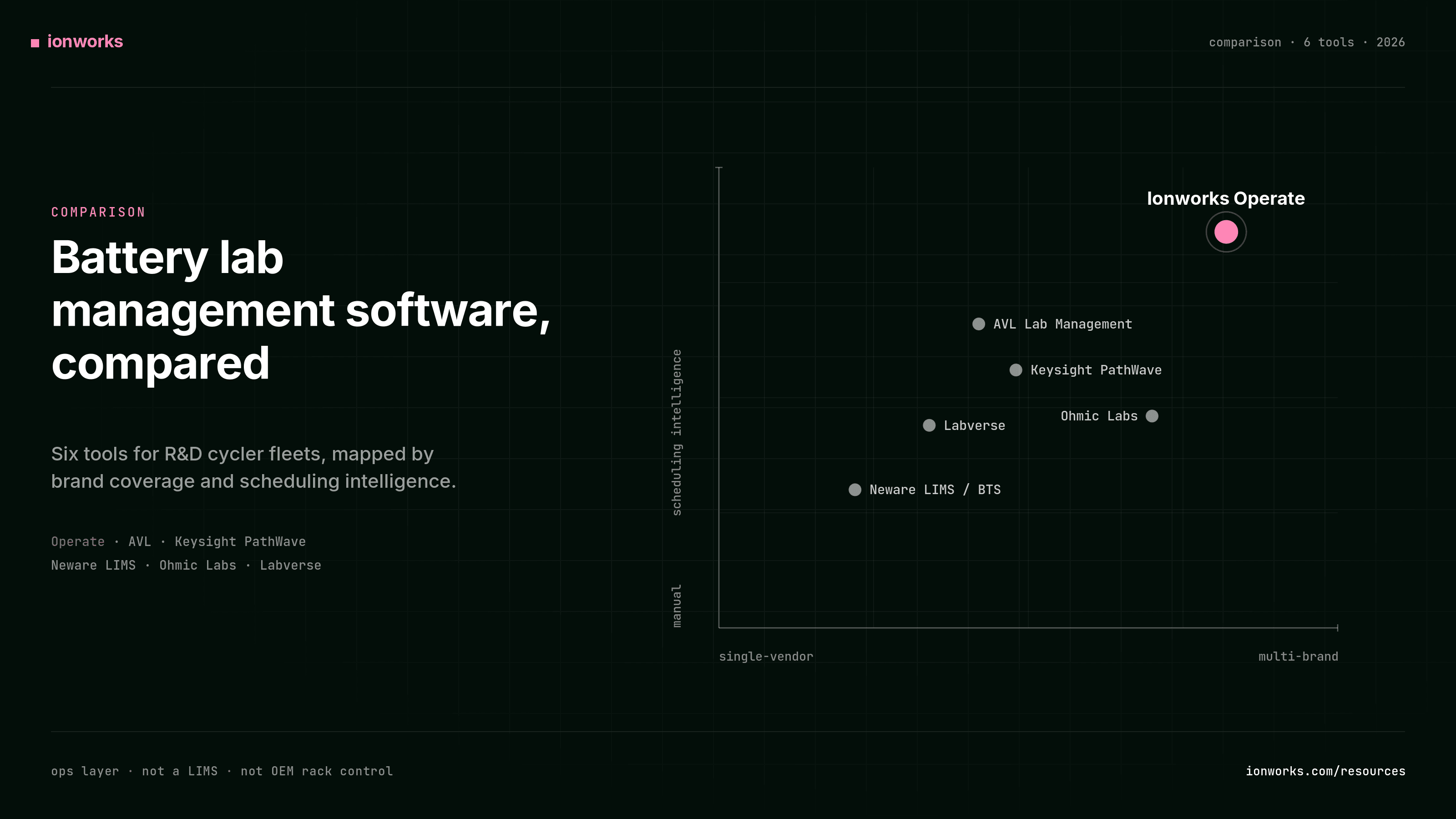
This comparison is published by Ionworks. We have aimed to represent each tool fairly based on publicly available documentation, product pages, and published technical specifications as of March 2026. Ops-focused lab management tools are covered separately in our battery lab management software comparison.
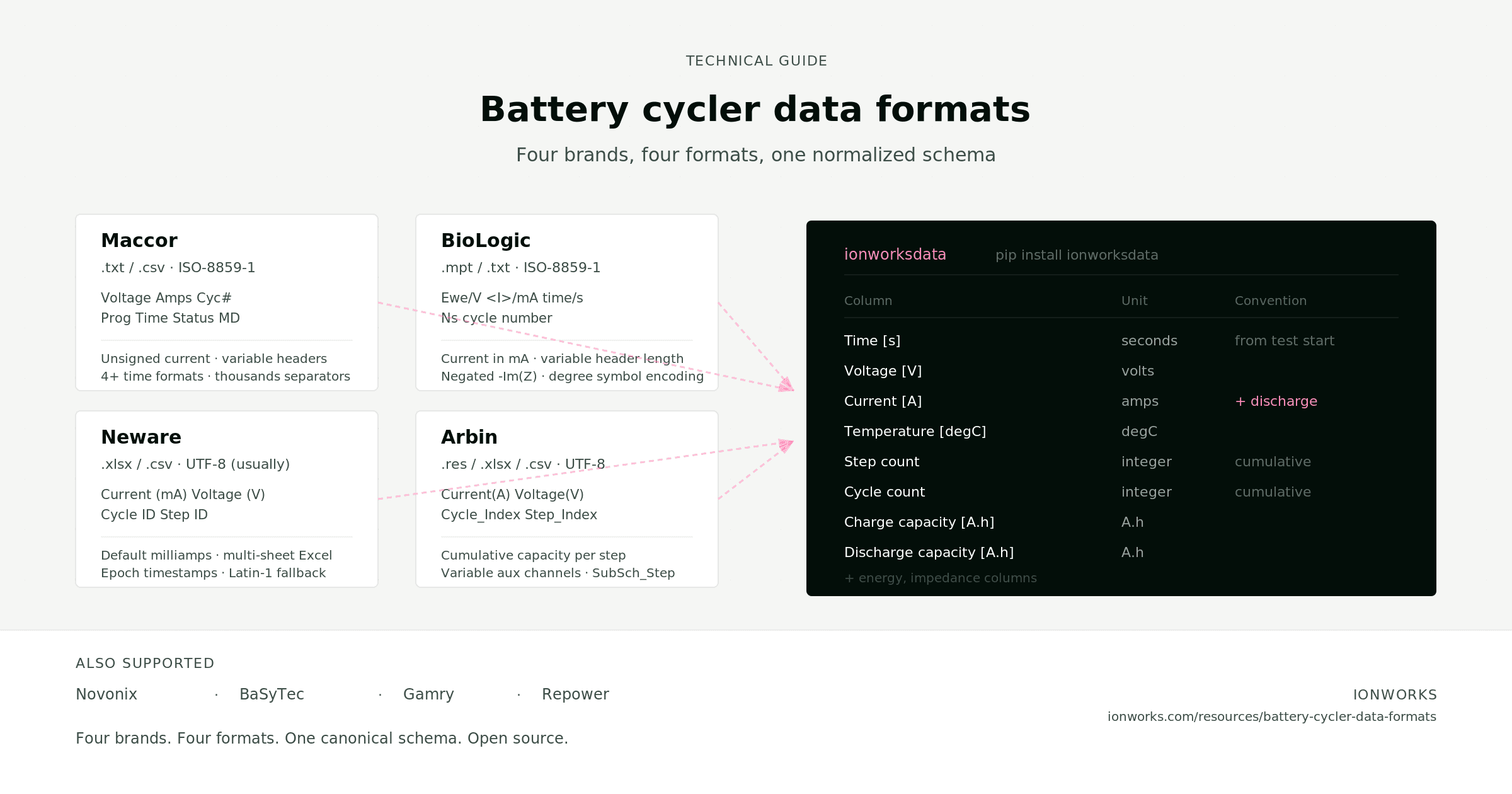
Most battery R&D teams have a cycler data problem they have learned to live with. Maccor exports land in one folder structure, Neware files follow a different convention, and BioLogic data gets its own post-processing script. Metadata lives in spreadsheets, naming conventions drift across team members, and the "system of record" is often someone's institutional memory.
Dashboards help with visibility, but they do not solve the deeper issue: getting structured, traceable data into models and engineering decisions. Teams running PyBaMM battery modeling workflows or building parameterized cell models need more than a plotting layer on top of raw files. They need a data platform that connects test results to simulation inputs without manual reformatting at every step.
This comparison evaluates five battery lab data management platforms on criteria that matter to technical buyers: data ingestion across major cycler formats, metadata and traceability, analytics depth, API and SDK extensibility, simulation readiness, and reproducibility. The goal is to help you distinguish between platforms that centralize battery test data and platforms that connect that data to validated models and engineering decisions.
What is a battery lab data management platform?
A battery lab data management platform organizes test data, experiment metadata, and cell context into a searchable, structured system. At minimum, it replaces the patchwork of shared drives, custom parsers, and one-off notebooks that most labs accumulate over time.
Some platforms expose APIs or SDKs so Python-first teams can automate ingestion, extraction, and analysis without leaving their existing workflows. A smaller subset connect structured lab data directly to simulation-ready workflows, supporting battery model development alongside core data management.
The best battery lab data management platforms in 2026
1. Ionworks
Best for: Teams moving from battery test data management into model parameterization, simulation, and optimization workflows.
Battery R&D teams generate data across multiple cycler platforms. Each has its own file formats and metadata schemas. The modeling problem starts here: a model fitted to misattributed or incomplete data produces predictions that carry hidden uncertainty. Ionworks Studio addresses this by organizing work around structured battery R&D objects: organizations, projects, cells, measurements, models, parameterized models, studies, simulations, protocols, and optimization. Test data arrives with the context needed to feed directly into model development.
Teams can upload and visualize experimental battery cycling data from major cycler formats, including Maccor, Neware, Novonix, Arbin, and BioLogic. The data hierarchy supports cell specifications, cell instances, cell measurements, time-series data, step summaries, and cycle metrics. Beyond time-series cycling data, Ionworks also supports checkpoint measurements such as cell images, processed thermal camera data, and single-value measurements like thickness.
The API and SDK story is concrete and well-documented. Ionworks provides a Python client (ionworks-api) for interacting with the platform programmatically. The SDK covers cell specifications, cell instances, cell measurements, pipelines, simulations, validation, and batch simulations. A REST API backs the Python client, so teams that prefer direct HTTP integration have that path too. For battery R&D teams that already write Python for data analysis or run PyBaMM battery modeling scripts, Ionworks fits into existing toolchains rather than replacing them.
Parameterized models are worth calling out specifically. In Ionworks, a parameterized model combines a model definition, a validated parameter set, and a cell specification into a reusable, immutable object. Once a model is parameterized and validated against lab data, other team members can run simulations against it without re-deriving parameters or worrying about version drift.
The platform covers data ingestion, parameter fitting, simulation, and optimization. For teams whose bottleneck is the gap between "we have cycling data" and "we have a validated cell model," Ionworks addresses that workflow explicitly. For the people who run the racks, Operate adds channel occupancy and test scheduling on top of the same structured measurements.
Pros:
- Structured battery R&D objects connect cell metadata, measurements, and models in a single hierarchy, reducing manual data wrangling between tools
- Public Python SDK with docs supports automation of data upload, simulation, validation, and batch runs via
pip install ionworks-api - Parameterized models combine model, parameter set, and cell spec into immutable, reusable simulation assets
- Cycler format coverage includes Maccor, Neware, Novonix, Arbin, and BioLogic, handling the most common multi-vendor lab setups
- Simulation and optimization built in means teams do not need a separate tool to move from test data to engineering decisions
- REST API access gives flexibility for teams integrating Ionworks into broader data pipelines or CI workflows
Cons:
- Broader scope than pure analytics means teams who only need a dashboarding layer may find the modeling and simulation features beyond their immediate needs
- Best fit for technical teams comfortable with Python and model-driven workflows; less oriented toward teams that prefer no-code analytics
2. Voltaiq
Best for: Labs prioritizing automated data harmonization, KPI extraction, and traceability across R&D and production workflows.
Voltaiq positions itself as an enterprise battery intelligence platform that automatically collects, cleans, and harmonizes data from test and production equipment. The platform emphasizes operational analytics: plotting data quickly, detecting anomalies early, running root-cause analysis, and tracing results back to upstream materials and process parameters.
The workflow covers automated data collection, cleaning and harmonization into a common format, feature and KPI extraction, traceability, no-code analysis, and shareable dashboards and reports. For teams whose primary pain is getting consistent, comparable data out of heterogeneous test equipment, Voltaiq addresses that ingestion-to-analysis pipeline directly.
On the API and SDK front, the reviewed sources emphasize Voltaiq's no-code analysis tools, dashboards, and automated data collection rather than public developer documentation. A data science environment (Analytics Studio) has been referenced in Voltaiq materials, but public SDK depth and REST API documentation were not confirmed in the sources reviewed for this comparison. Teams that need programmatic access should verify API object coverage, authentication model, and automation capabilities during evaluation.
Pros:
- Automated data harmonization collects and normalizes data across test and production equipment into a common format
- KPI and feature extraction supports repeatable analytics without manual scripting for common metrics
- No-code analysis and dashboards lower the barrier for non-Python team members to access and share results
Cons:
- Public API/SDK depth less visible based on reviewed sources; teams needing deep programmatic access should verify during evaluation
- Voltaiq's strength is analytics and operational visibility. Teams that need to move from data into model parameterization or PyBaMM workflows will need a separate tool for that stage
3. Micantis
Best for: Teams combining R&D analytics, quality control workflows, and multi-cycler data management with developer tooling needs.
Micantis is a battery quality analytics platform that covers incoming quality control, manufacturing QC, and R&D test optimization. For the purposes of this comparison, the R&D angle is most relevant: Micantis helps teams manage test data across multiple cyclers and predict scale-up challenges early.
The data ingestion coverage is strong. Micantis claims support for 50+ battery file formats with automated import from major cyclers including Arbin, Maccor, Neware, Bitrode, BioLogic, and Basytec. LIMS integrations include LabWare, STARLIMS, LabVantage, Benchling, Uncountable, and LabVIEW, which is useful for teams that need their battery data platform to connect to existing lab infrastructure.
On the API and SDK side, Micantis publicly markets a Python SDK (pip install micantis), Jupyter notebook integration, Pandas DataFrame support, and APIs for custom integrations. The site also references a "Build Your Own (API Only)" path. That level of public SDK messaging is stronger than what most competitors surface, though teams should verify the depth of object coverage and authentication workflows during evaluation.
Analytics capabilities include dQ/dV analysis, EIS, HPPC, DCIR, DRT, automated pass/fail evaluation, SPC monitoring, and cycle life prediction from early formation data. Micantis is clearly stronger on analytics and QC than on simulation or model parameterization.
Pros:
- 50+ file formats supported with automated import from Arbin, Maccor, Neware, Bitrode, BioLogic, and Basytec
- Public Python SDK and API with
pip install micantis, Jupyter integration, and Pandas DataFrame support - LIMS integrations connect to LabWare, STARLIMS, LabVantage, Benchling, Uncountable, and LabVIEW
- Advanced electrochemical analysis includes dQ/dV, EIS, HPPC, DCIR, and DRT out of the box
Cons:
- Stronger on analytics than simulation. Teams that need to move from data into parameterized models or battery simulation workflows will need a separate tool
- Public docs depth needs verification since SDK claims are visible in marketing but full developer documentation was not independently confirmed in this review
4. Batalyse
Best for: Labs standardizing heterogeneous electrochemical test data across many instruments and file structures.
Batalyse describes itself as automated data processing software for battery, redox flow battery, and fuel cell R&D and quality management. Its product is structured into four modules: Collect (research data management), Data Analysis (electrochemical test data evaluation), Mind (lab management), and EIS Analyzer (impedance analysis).
The device and file-structure compatibility is a clear strength. Batalyse lists support for equipment from Arbin, AVL, Basytec, BioLogic, Ivium, Keysight, Lanhe, Maccor, Neware, Origalys, and PEC. The Data Analysis module can evaluate files from a local file system, the Batalyse Collect database, or a team's own database. For labs running many instrument brands simultaneously, that flexibility reduces the custom-parser burden.
The platform automates repetitive data evaluation steps and supports specimen parameters, result tables, and diagrams. Public evidence of a REST API or Python SDK was not found in the sources reviewed here. Batalyse does state that teams can "access refined data with their own code and AI," which implies some level of programmability or export capability. Teams that need scripted access should ask specifically about API endpoints, authentication, and data export formats during evaluation.
Pros:
- Broad device compatibility supports Arbin, AVL, Basytec, BioLogic, Ivium, Keysight, Lanhe, Maccor, Neware, Origalys, and PEC
- Flexible data source evaluation reads from local file systems, Batalyse Collect, or external databases
- Automates repetitive data tasks across evaluation, specimen tracking, and result generation
- EIS Analyzer module provides dedicated impedance analysis alongside general data processing
Cons:
- Public SDK evidence less visible. Teams that need Python-first or API-driven automation should verify integration depth before committing
- Free trial available for the Data Analysis module, which helps teams evaluate before committing
5. AVL
Best for: Enterprises standardizing battery lab operations within a broader testing and development software stack.
AVL offers lab management software positioned for battery development and testing workflows. The company is well known in the automotive and powertrain testing space, and its battery-focused tools sit within a broader ecosystem of test automation, data management, and engineering software.
For large organizations that already use AVL for powertrain or vehicle-level testing, adding battery lab management within the same vendor ecosystem may simplify procurement and IT integration. AVL's relevance here is as a lab operations layer rather than a specialized battery data analytics or simulation platform.
Public detail on API or SDK access specifically for battery data workflows was not confirmed in the sources reviewed. Battery-data-specific capabilities like multi-cycler format parsing or structured cell metadata hierarchies were not surfaced with the same granularity as other platforms in this comparison. Teams evaluating AVL for battery lab data management should request detailed capability walkthroughs specific to their cycler and data requirements.
Pros:
- Battery development and testing focus is explicit in AVL's product positioning for lab management
- Broader testing ecosystem connects battery workflows to AVL's powertrain, vehicle, and system-level tools
- Enterprise procurement fit may simplify vendor management for organizations already in the AVL ecosystem
Cons:
- Public API/SDK depth unclear for battery-specific data workflows based on available sources
- Less battery-data-specific detail surfaced compared to platforms built primarily for cycler data management and analysis
Summary table
| Platform | Best for | Key differentiator |
|---|---|---|
| Ionworks | Data-to-model workflows | Structured R&D objects, Python SDK, simulation and optimization |
| Voltaiq | Analytics and traceability | Automated harmonization, KPI extraction, no-code dashboards |
| Micantis | R&D analytics and QC | 50+ formats, LIMS integrations, public Python SDK |
| Batalyse | Electrochemical data processing | Broad device support, flexible data sources, EIS analysis |
| AVL | Battery lab management | Enterprise testing ecosystem, broader lab operations |
Why Ionworks stands out here
Every platform in this comparison centralizes battery test data. The question is what happens after ingestion.
Voltaiq and Micantis turn that data into dashboards, KPI extractions, and QC metrics. Ionworks turns it into parameterized models, simulations, and optimization runs, within the same environment where the data was imported. The Python SDK covers the full workflow, so a team can script data upload, run parameterization, trigger batch simulations, and extract validation results without switching tools.
That matters most at the handoff points. When a parameter set is fitted against cycling data, the provenance of that fit stays attached to the resulting model. When a colleague runs a simulation six months later, they inherit the same validated inputs without tracking down notebooks or asking which spreadsheet has the latest values. The platforms that stop at analytics leave those handoff points to ad hoc tooling.
Voltaiq and Micantis are both strong platforms. Teams whose primary problem is getting clean, comparable data from heterogeneous test equipment will find real value there. But for teams whose bottleneck is the transition from structured test data to validated cell models and engineering decisions, Ionworks addresses that workflow directly.
How we chose the best battery lab data management platforms
We compared each platform across six criteria grounded in actual battery R&D workflows.
Data ingestion and normalization. Battery labs rarely use a single cycler vendor. We checked whether each platform supports automated import across Maccor, Neware, Arbin, BioLogic, and similar environments, and whether normalization happens automatically or requires custom scripting.
Metadata and traceability. Raw time-series files are only useful if connected to cell specifications, batch context, and process parameters. We looked for structured metadata hierarchies rather than flat file stores.
Analytics depth. Does the platform support repeatable analysis, KPI extraction, and cross-experiment comparison? Or does it primarily provide visualization?
API and SDK extensibility. For Python-first teams, programmatic access is not optional. We reviewed public documentation for REST APIs, Python SDKs, and developer-facing workflows. Where public evidence was thin, we said so.
Simulation readiness. We evaluated whether the platform connects lab data to model parameterization, simulation, or optimization workflows, or whether it stops at the analytics layer.
Reproducibility and coordination. We looked for features that support repeatable analyses, immutable model versioning, and shared project structures that keep results traceable across team members and time.
All assessments were based on official documentation, product pages, and publicly available materials. We avoided relying on marketing claims that could not be cross-referenced with docs or product evidence.
Frequently asked questions
Continue reading