This comparison is published by Ionworks. We have aimed to represent each tool fairly based on publicly available documentation, product pages, and published materials as of July 2026.
"Battery lab management" means two different products in search results. One organizes files and metadata for analysis and models. The other coordinates channels, test requests, and schedules so the lab knows what is running and what runs next.
This page is the second category: ops. For the first, see our battery lab data management platforms comparison. Confusing the two wastes evaluation time. A dashboard of capacity fade does not book the next free Arbin channel. A chamber logistics system does not parameterize a PyBaMM model.
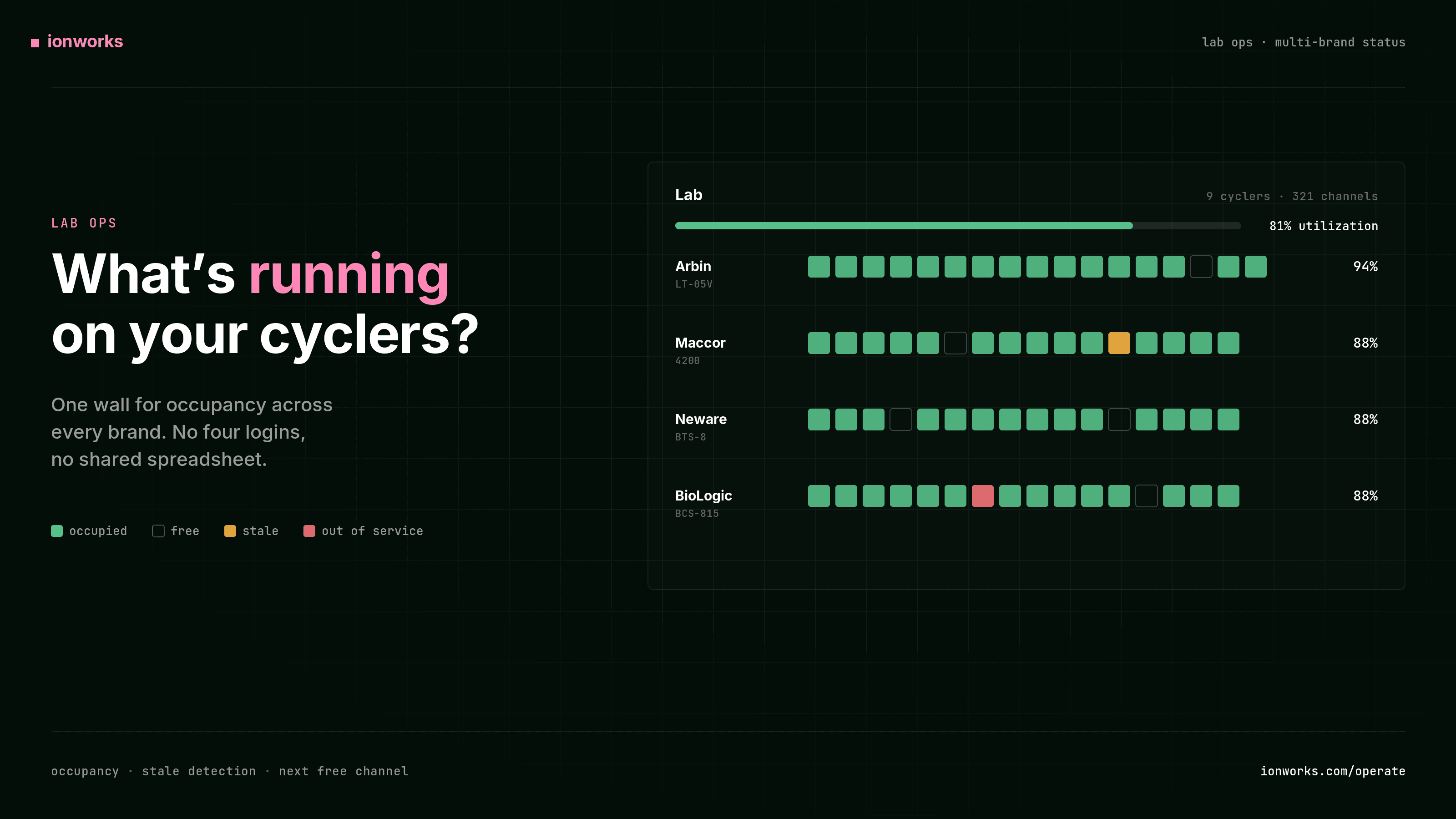
The day-to-day ops question is simpler: what's running on your cyclers across Arbin, Maccor, Neware, and BioLogic, and how does a test request become a booked slot without a shared spreadsheet?
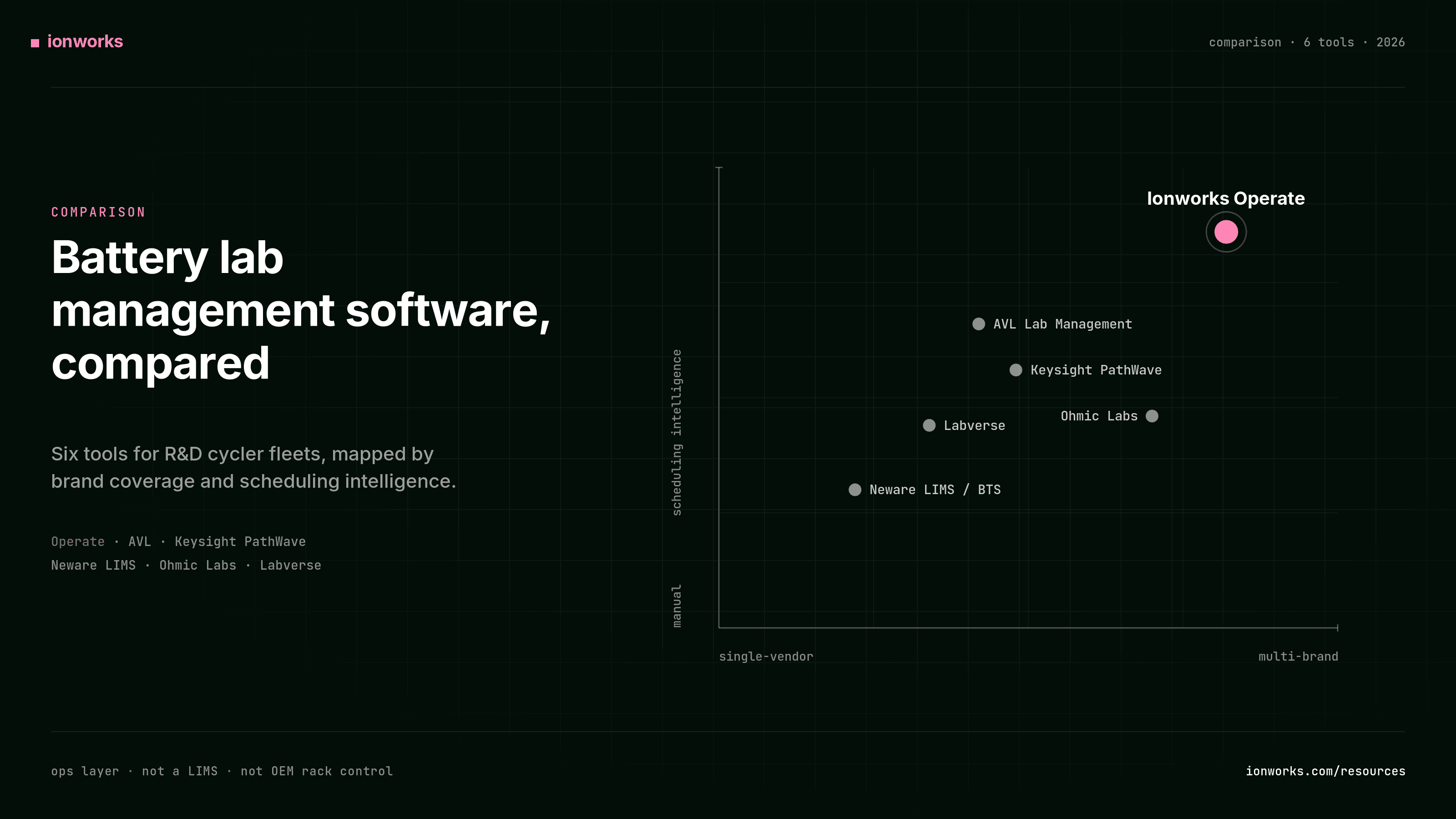
This comparison evaluates six battery lab management options on criteria that matter to test engineers and scheduling teams: multi-brand channel status, test request and scheduling workflow, scope versus a full LIMS, mid-lab versus enterprise fit, connection to structured cycler data, and whether day-to-day ops questions can be answered without opening every OEM UI.
What is battery lab management software?
In the ops sense, battery lab management software coordinates people, channels, and test requests. At minimum it answers:
- What is occupied, free, or stale right now?
- Who asked for the next test, and on which resource?
- When can that test start?
Enterprise systems go further: climatic chambers, UUT logistics, roles, maintenance intervals, and utilization across multi-site test fields. OEM clients (Arbin MITS, BioLogic BT-Lab, Neware BTS) control and monitor their racks. A full LIMS adds samples, methods, compliance, and report release.
Ionworks Operate sits in the middle of that map: a multi-brand channel wall and scheduler on the same structured measurements as Measure, not a chamber MES and not a sample LIMS.
Battery lab management software in 2026
1. Ionworks Operate
Best for: Mid-size R&D labs that need up-to-date status across mixed cycler brands and a test-request path into a booked channel, without standing up enterprise LMS or a full LIMS.
Ionworks Operate is the ops surface for Ionworks. The channel wall shows utilization and per-channel state across the fleet. Test scheduling simulates each protocol to predict run time, so a request becomes a booked slot with a realistic start and estimated end. An agent answers operational questions in plain language against the same structured data path used for analysis and modeling.
The wedge is multi-brand status, physics-predicted scheduling, and a plain-language agent, all on the same Ionworks measurements used for analysis and modeling. Teams already ingesting Maccor, Neware, Arbin, and BioLogic into Measure can run ops on that layer instead of maintaining a parallel spreadsheet. For the people who run the racks, that is the gap OEM UIs leave open: each vendor sees its own channels, not the wall.
Ionworks Operate is not a sample LIMS and not a replacement for starting or stopping a single-vendor rack in the OEM client. It is the shared ops view and booking layer.
Pros:
- Multi-brand channel wall for Arbin, Maccor, Neware, and BioLogic fleets instead of one UI per vendor
- Simulation-predicted run times so a test request becomes a booked channel with a realistic start and finish, not a manual estimate
- Same data path as Measure so occupancy and measurements share structured objects
- Plain-language agent that reads live occupancy and the queue to answer day-to-day ops questions on that data
- Mid-lab scope that ships without enterprise chamber logistics
Cons:
- Not a full LIMS. Sample receiving, CNAS-style methods, and report release need a dedicated LIMS if that is the requirement
- Not OEM rack control. Start/stop and deep vendor features stay in Arbin MITS, BioLogic BT-Lab, Neware BTS, and similar
- Enterprise test-field logistics (chamber routing, UUT preparation tablets, multi-site energy balancing) are stronger in AVL / Keysight-class platforms
2. AVL Lab Management for Battery
Best for: Large battery test fields that need work-order planning, chamber logistics, and utilization at scale inside a broader AVL testing ecosystem.
AVL Lab Management for Battery targets labs running hundreds or thousands of cells, modules, or packs under varied climatic conditions. Public materials emphasize intelligent scheduling from the test request, smart logistics across chambers with different profiles, live monitoring of test chambers, maintenance and calibration intervals, central data repositories, and energy-aware planning that balances charge and discharge load on the facility.
For organizations already deep in AVL powertrain or vehicle testing, staying in that vendor stack can simplify procurement and IT. The product story is test-field efficiency and OEE, not a lightweight multi-brand R&D wall for a single bay of mixed cyclers.
Pros:
- Work order and planning module from test request through resource allocation
- Chamber and logistics support for heterogeneous climatic profiles and high UUT volume
- Enterprise testing ecosystem that connects battery labs to broader AVL development tools
- Open architecture messaging for third-party hardware and software integration
Cons:
- Heavyweight for mid-labs whose pain is a shared spreadsheet and three OEM UIs, not thousands of annual orders
- Public depth on multi-brand R&D channel walls is thinner than purpose-built mid-market tools; verify your cycler mix in a demo
- Procurement and implementation typically track enterprise LMS projects, not a seeded ops demo for one lab bay
- No physics-based run-time prediction or agent ops in public materials. Scheduling optimizes logistics and utilization, not simulating each protocol to predict how long a test runs, and there is no natural-language agent over live channel status
3. Keysight PathWave Lab Operations for Battery Test
Best for: Labs that want a browser-based operations layer for resources, DUTs, lab orders, and asset utilization, especially alongside Keysight / Scienlab test systems.
PathWave Lab Operations for Battery Test (EP1150A) positions as an integrated web platform to replace paper and spreadsheet coordination. Public materials emphasize planning and optimizing test capacities and sequences, registering and tracking test objects, organizing documents, tasks, and lab orders, notifications, and a 360-degree view of assets, software, test plans, results, and reports. Scalability messaging covers small labs through multi-site deployments with large channel counts.
PathWave is an operations and resource coordination product. It is distinct from PathWave Test Automation, which focuses on executing technical test plans. Teams evaluating Keysight should confirm how mixed third-party cyclers (Arbin, Maccor, Neware, BioLogic) appear in the occupancy and scheduling views versus Keysight-native systems.
Pros:
- Browser-based lab management for people, hardware, and information in one place
- Lab order and capacity planning aimed at throughput and asset utilization
- DUT registration and traceability as a first-class workflow
- Modular PathWave suite so labs can add modules over time
Cons:
- Strongest story next to Keysight hardware; multi-vendor R&D walls need explicit verification in evaluation
- Enterprise ops breadth may exceed what a mid-lab needs to replace a spreadsheet scheduler
- Data-to-model handoff is not the product focus; pair with a data platform if parameterization is the next bottleneck
- No simulation-predicted test durations or agent layer in public materials; scheduling centers on capacity and asset utilization rather than physics-based run times
4. Neware LIMS and BTS
Best for: Neware-heavy labs that need sample-to-report process control (LIMS) plus the OEM client for running channels (BTS).
Neware publishes two related layers. Neware LIMS is a laboratory information management system oriented toward equipment, samples, personnel, methods, and reports, with CNAS-style compliance messaging. Public materials also describe managing channels across testers, including claims of non-Neware brand coverage, and a full cycle from test apply through report upload. Separately, BTS (Battery Testing System client/server) is the day-to-day software for editing schedules, starting channels, and monitoring Neware hardware.
Treat LIMS and BTS as a stack, not a single mid-lab wall. LIMS answers sample and compliance workflows. BTS answers OEM control. Neither is primarily a brand-agnostic R&D occupancy product sitting on a third-party data model for simulation.
Pros:
- Sample and process coverage from apply through report audit
- CNAS-oriented LIMS framing for regulated testing labs
- Tight fit with Neware hardware via BTS for execution
- Resource and channel management messaging for lab-wide coordination
Cons:
- Strongest on Neware-centric deployments; multi-brand depth should be proven against your Arbin / Maccor / BioLogic mix
- Full LIMS scope is more than mid-labs need if the only gap is occupancy and booking
- Modeling and parameterization remain outside the LIMS/BTS core; plan a separate data-to-model path if that matters
5. Ohmic Labs
Best for: Teams whose bottleneck is building, simulating, versioning, and deploying protocols across cycler brands, with fleet monitoring as part of that loop.
Ohmic Labs positions as a battery test management platform: browser protocol builder, electrochemical simulation to validate logic before hardware, export/deploy to popular cycler brands, and fleet manager dashboards for what is happening on tools. Public messaging targets the cost of homegrown remote monitoring and the risk of debugging protocol logic on physical cells.
Ohmic is the closest mid-market narrative peer to Ionworks Operate in SERPs: ops software for mixed fleets, not an automotive enterprise LMS. The center of gravity differs. Ohmic leads with protocol lifecycle. Ionworks Operate leads with live occupancy and test scheduling on Ionworks measurements, with an agent on that data.
Pros:
- Protocol builder and versioning aimed at replacing folder sprawl of schedule files
- Simulate-before-deploy framing to catch logic errors off hardware
- Multi-brand deploy and fleet monitor messaging for mixed labs
- Mid-market product shape closer to R&D bay workflows than chamber MES
Cons:
- Newer vendor; verify production cycler integrations against your exact firmware and file paths in a trial
- Data platform and modeling depth are not the primary claim; teams needing parameterized models still need a data layer
- Enterprise chamber logistics are out of scope by design
6. Labverse
Best for: Organizations shopping for a battery-oriented LIMS with AI agents for planning and analysis orchestration, not only a channel wall.
Labverse describes an intelligent LIMS grounded in lab-informatics standards (ASTM E1578, ISO/IEC 17025 messaging) covering samples, instruments, personnel, and workflows, plus AI agents that parse documents, generate experiment plans, and run multi-step analyses. The Coord suite framing spans management, engineering, battery data, AI, and integration.
Labverse competes more with LIMS + agent orchestration than with a lightweight occupancy product. Evaluate it when compliance, sample lifecycle, and agent-driven experiment planning are in scope. For "what is free on the Neware and when can we book it," confirm the channel-wall experience explicitly.
Pros:
- LIMS backbone for samples, devices, personnel, and workflows
- Standards-oriented compliance messaging for regulated labs
- AI agents framed as workflow orchestrators, not chat-only
- Battery R&D focus rather than generic life-science LIMS only
Cons:
- Broader than mid-lab occupancy; implementation looks like a LIMS project
- Public channel-wall and multi-OEM scheduling detail should be verified in a product walkthrough
- Overlap with data platforms means clarifying where Labverse stops and modeling tools begin
OEM control software (not full lab management)
Arbin MITS, BioLogic BT-Lab / Global View, Neware BTS, and Maccor clients remain the right place to control a rack. They answer "start this schedule on these channels" for their hardware. They rarely answer "what is free across every brand in the building" without custom integration. Treat OEM UIs as execution tools. Treat lab management software as the shared ops layer, or accept that the shared layer is still a spreadsheet.
Summary table
| Platform | Best for | Key differentiator |
|---|---|---|
| Ionworks Operate | Multi-brand status and scheduling on Ionworks data | Ops wall on the same measurements as Measure |
| AVL Lab Management | Enterprise test-field utilization | Work orders, chambers, logistics at scale |
| Keysight PathWave | Browser lab orders and asset coordination | Resource / DUT / workflow management |
| Neware LIMS / BTS | Sample-to-report on Neware-heavy labs | CNAS-oriented LIMS plus OEM client |
| Ohmic Labs | Protocol build, simulate, deploy, monitor | Protocol-first multi-brand tooling |
| Labverse | Battery LIMS with AI agents | Sample / compliance LIMS + orchestration |
Where Ionworks Operate fits
Enterprise LMS products optimize large test fields. OEM clients optimize one vendor's channels. Full LIMS products optimize samples and compliance. Mid-labs still lose hours to the gap between those layers: stale status across brands and test requests that live in chat or a sheet.
Ionworks Operate is built for that gap. Occupancy and scheduling sit on the same structured objects as Measure, so ops does not invent a second source of truth. The agent answers questions against that data. Modeling and parameterization remain one hop away instead of a CSV export.
Choose AVL or Keysight when chamber logistics and multi-site OEE are the buying criteria. Choose Neware LIMS or Labverse when sample lifecycle and compliance are. Choose Ohmic when protocol authoring and deploy are the bottleneck. Choose Ionworks Operate when the bottleneck is knowing what is running across brands and scheduling the next test on run times predicted by simulation, with an agent on the same data. That scheduling-intelligence layer applies whether the lab has twenty channels or a thousand, so many enterprise labs will want it alongside a chamber-logistics platform rather than choosing one over the other.
How we chose these battery lab management tools
We compared each option across six criteria grounded in R&D lab ops, not marketing category labels.
Multi-brand channel status. Can the team see Arbin, Maccor, Neware, and BioLogic without three remote-desktop sessions?
Test request and scheduling. Does a request become a booked resource, or does scheduling stay informal?
Scope versus full LIMS. Is the product a channel/ops layer, a sample LIMS, or both? Overbuying LIMS for an occupancy problem is a common failure mode.
Mid-lab versus enterprise fit. Chamber routing and energy balancing matter at scale. Spreadsheet replacement matters at twenty to a few hundred channels.
Connection to structured cycler data. Ops that cannot point at the same measurements used for analysis creates another silo.
Agent or automation for ops questions. "What's free on the Maccor?" should not require tribal knowledge.
Assessments used official product pages, datasheets, and public docs. Where public evidence was thin, we said so and recommend hands-on verification.
Frequently asked questions
Continue reading