A 1D physics-based battery model tells you how a cell performs. It resolves the electrochemistry through the electrode stack and predicts voltage and capacity fade under load. For most questions during early parameterization and chemistry screening, that is enough.
At some point the question changes. It stops being "how does this cell perform" and becomes "where in this cell does performance break down." That is a spatial question, and 1D cannot answer it.
Full 3D physics-based battery simulation is available in Ionworks, built on PyBaMM. If you already have a parameterized model, you can run it in 3D without rebuilding anything.
What 1D cannot tell you
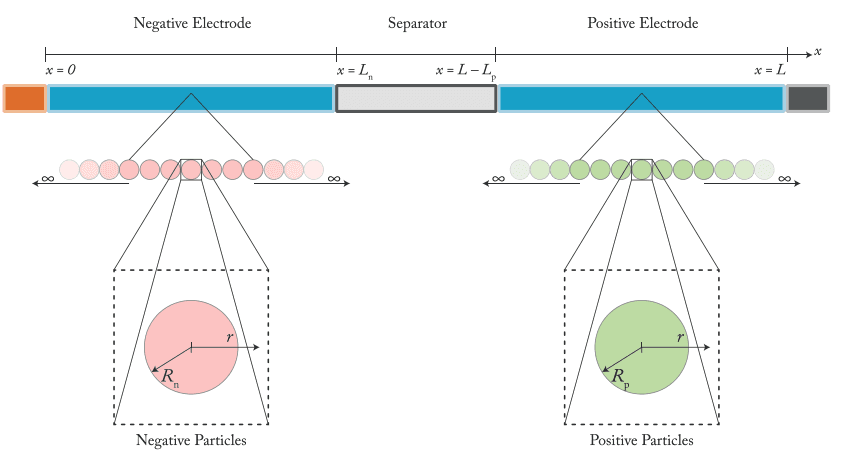
DFN and SPMe resolve electrochemistry through the thickness of the electrode sandwich. They do this well. The assumption baked into both is lateral uniformity: every point across the cell face sees the same current density, potential, and temperature.
The assumption holds when the cell is small, the tabs are centered, and the C-rate is modest. It starts to fail when any of those change.
Spatial gradients and current distribution
In a real pouch or prismatic cell, current enters through the tabs and spreads across the current collectors before passing through the electrode stack. Current density is highest near the tabs and decays toward the far edges of the cell.
A 1D model averages this distribution away entirely. It treats the full electrode area as if it were uniformly loaded. For a large-format cell at high rate, the difference between local current density near a tab and at the opposite corner can be substantial, and that gradient drives real differences in local overpotential, lithium concentration, and aging.
Tab location and internal resistance
Tab position directly changes the effective current path through the collectors. A top-top configuration forces current to traverse the full collector length. A top-bottom or diagonal arrangement shortens the average path and reduces ohmic losses.
Tab placement has a measurable effect on DC internal resistance: two otherwise identical cells in different tab configurations produce different resistance profiles under the same operating conditions. A 1D model has no representation of tab geometry, so it cannot distinguish between these configurations at all.
Thermal hotspots
Heat generation in a cell is proportional to local current density. Where current concentrates, heat generation is highest. In a pouch cell, that means the region near the tabs runs hotter than the rest of the cell.
A lumped thermal model reports one temperature: the average. A 1D coupled thermal-electrochemical model can resolve through-thickness gradients but still assumes lateral uniformity. Only 3D predicts where the hotspot actually forms, and the temperature difference between that hotspot and the cell edge can be large enough to shift local degradation rates.
Large-format cell behavior
Pouch and prismatic cells with large electrode areas are where these effects compound. Lateral gradients in current density create lateral gradients in state of charge. One region of the cell can be at 85% SoC while another sits at 70%.
Those SoC gradients drive non-uniform aging. The high-current region near the tabs ages faster. Under cold-temperature fast charging, it is also the region most likely to plate lithium first, because local overpotential is highest there. A 3D battery simulation captures all of these coupled spatial effects. A 1D model, by construction, cannot.
3D simulation, available in Ionworks
Ionworks supports full 3D electrochemical-thermal simulation. The solver couples DFN-class electrochemistry at each point on the cell face with 3D current conduction through the collectors and 3D heat transport, built on PyBaMM and the same underlying architecture described in our PyBaMM vs COMSOL comparison.
You define your cell geometry (tab locations, electrode dimensions, collector properties) and run the same physics you have already been using for 1D studies. The equation set is PyBaMM, the parameter set is the one you already fit in Train, and the environment is the one your team already works in. Dimensionality becomes a simulation setting rather than a tooling change.
Live simulation · available in Ionworks
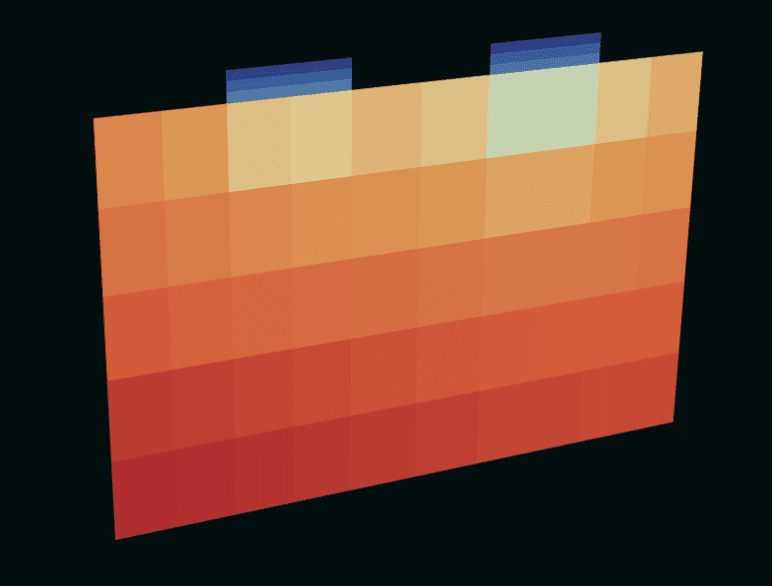
Full 3D DFN over a 1C discharge and relaxation
A browser-rendered time series from a full 3D DFN simulation of a pouch cell, discharged at 1 A for 30 minutes and then relaxed. Step through the profile to see where the thermal response localizes and how the current load drives it.
Loading /models/pouch_dfn_polydata/pouch_dfn_0000.vtk
The workflow problem this closes
This is the broader pattern we have written about before: battery simulation workflows break at the handoffs between teams and tools. The 1D-to-3D jump is a canonical example.
The common workflow today looks like this. Build and validate a 1D model in PyBaMM, get good agreement with half-cell and full-cell data, then realize you need spatial resolution. At that point, you open COMSOL or GT-Suite and start over.
You re-enter parameters. You rebuild the electrochemistry in a different modeling paradigm. You learn a new meshing interface, a new solver configuration, and a new post-processing environment. The 3D model you end up with may use the same governing equations, but it is a completely separate artifact from your 1D model, maintained in a different tool by (often) a different person.
Any time you update a kinetic parameter, swap an electrolyte transport dataset, or revise a degradation submodel in the 1D workflow, you have to manually propagate the change into the 3D model. In practice, the two models drift apart.
No model rewrite
In Ionworks, 1D and 3D live in the same environment, use the same PyBaMM equation set, and read the same parameter set. Your validated parameters, your cell specification, and the electrochemical model you picked (DFN, SPMe, or custom) stay fixed as you change dimensionality.
There is no translation layer between tools. No reformatting parameters for a new solver. No rederiving a kinetic rate constant because a different modeling paradigm expects it written differently. If you update a diffusion coefficient in your 1D work, the 3D run you set up next reads from the same parameter set.
One platform from 1D to 3D
Teams stay in one environment. The simulation protocols you have already configured (rate tests, GITT, drive cycles) work at both dimensionalities. You compare 1D and 3D results in the same interface, against the same experimental data.
Moving from exploratory 1D screening to full 3D spatial analysis does not mean switching battery simulation software or rebuilding parameter databases in a new tool. The cost of asking a 3D question drops from "new project" to "new simulation run."
When to reach for 3D
Not every question requires 3D. A 1D DFN model is fast, well-understood, and sufficient for chemistry-level and protocol-level studies. 3D is warranted when geometry influences the answer.
Tab placement evaluation. If you are comparing top-top, top-bottom, or diagonal tab configurations, you need a 3D electrochemical model. The resistance effect is invisible to 1D.
Large-format cell design. Cells above roughly 20 Ah with large electrode areas have meaningful lateral gradients. If you are designing a new pouch or prismatic format, 3D simulation quantifies those gradients before you build prototypes.
Thermal management design. Cooling strategy decisions (tab cooling vs. surface cooling, cold plate placement) depend on knowing where heat is generated, not just how much. 3D gives you the spatial heat map.
Validating 1D assumptions. Sometimes the most useful 3D simulation is the one that confirms your 1D model is adequate for a given geometry and operating condition. Running a 3D case as a check gives you confidence that lateral gradients are small enough to ignore for the cell format you are working with.
Get started
Full 3D physics-based battery simulation is available in Ionworks today. If you have a parameterized model, you can run your first 3D simulation on the cell you are already working with. Book a demo, or read more about 3D electrochemical models and where they change the answer.
We are adding more models and form factors in the coming months. If you have a specific cell format or use case you want to run in 3D, get in touch. We are building this with the teams who need it.
Continue reading